Models
This section describes every model a BayMorph fit is built from: the morphology of the galaxy, and the observation effects that turn it into the expected image of the detector. Each page gives the definition, the parameters with their units, domains and default priors, what the model represents and what it does not, its known degeneracies, its validation status, how to select it, and the references its model and formulas come from, each linked to its record in NASA ADS.
From a model to an expected image
The expected value of the pixel at position \(\mathbf{x}\) is
where \(I\) is the intrinsic surface brightness of the galaxy, the sum of its morphological components, \(P\) is the point-spread function of the observation, and \(B\) is the residual background. The morphology describes the source; the PSF, the pixel response and the background describe the measurement, and never change the meaning of a morphological parameter.
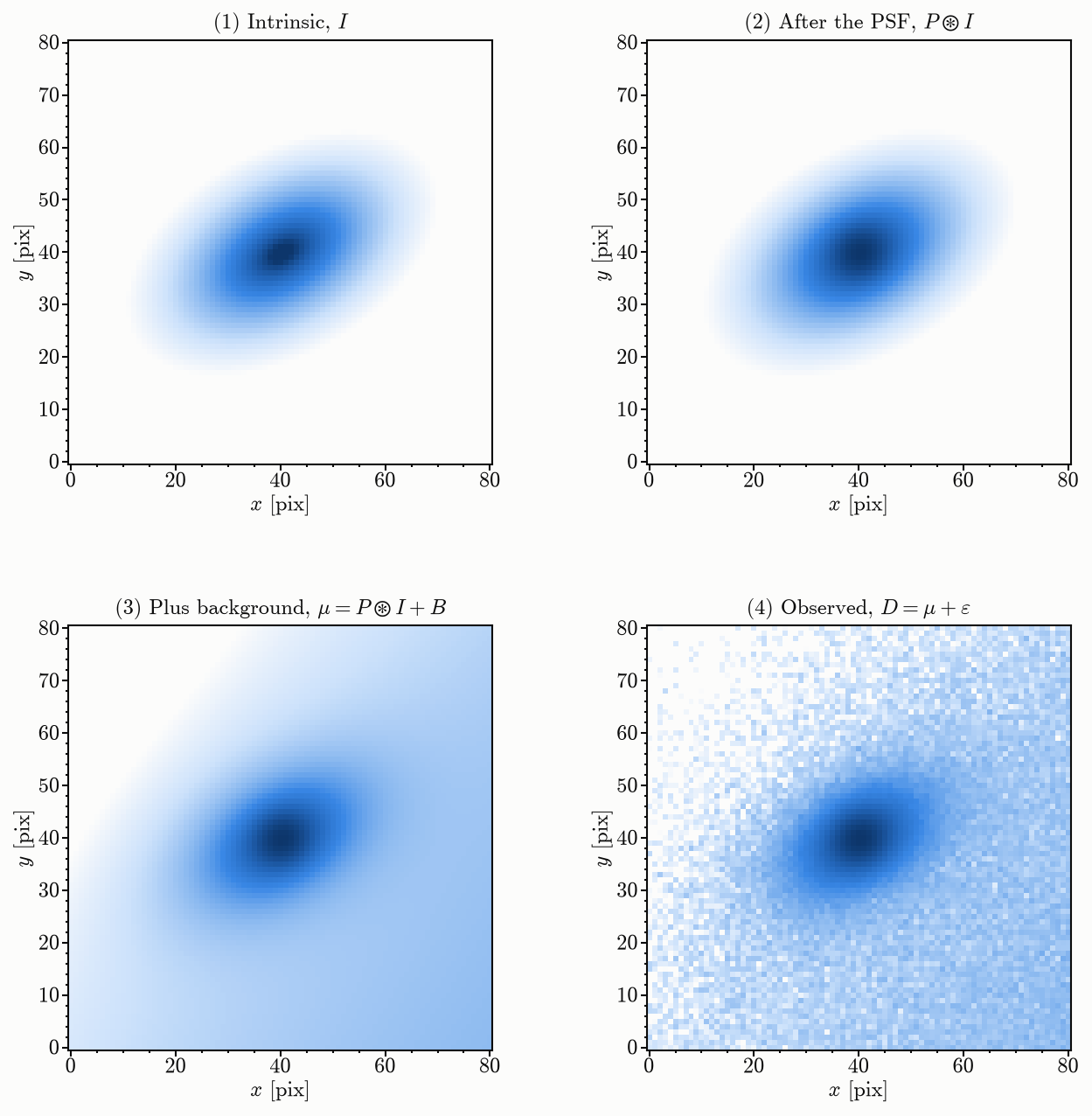
In order, from (1) to (4): the intrinsic profile, its convolution with a Gaussian PSF of 5 px FWHM, the residual background added, and an observation with noise. The colour scale is logarithmic and shared by the four panels.
| Part | Models | Page |
|---|---|---|
| Morphological components | nine components: Sérsic, exponential disc, point source, generalized Sérsic, core-Sérsic, broken exponential disc, Ferrers bar, Gaussian ring, exponential disc with spiral arms | Components |
| Galaxy models | single_sersic, double_sersic, sersic_point_source, bulge_disk; boxy_sersic, core_sersic, bulge_broken_disk, bulge_disk_bar, bulge_disk_ring, bulge_disk_spiral |
one page each, below |
| Point-spread function | Gaussian, empirical | Point-Spread Functions |
| Noise | correlated Gaussian; experimental Poisson likelihoods | Noise Models |
| Sky and residual background | sky subtraction; constant, plane | Sky and Background |
A new model of any kind gets its own page in the matching group, with the same structure: definition, parameters, what it represents, degeneracies, validation, configuration and references.
The galaxy models
| Model | Components | Sampled morphology parameters | Use |
|---|---|---|---|
single_sersic |
one Sérsic | 7 | the baseline description of a galaxy |
double_sersic |
two labelled Sérsic components, shared centre | 12 | a galaxy whose profile one Sérsic cannot describe |
sersic_point_source |
Sérsic and unresolved source, shared centre | 8 | a galaxy with an unresolved nucleus |
bulge_disk |
Sérsic bulge and exponential disc, shared centre | 11 | a bulge and disc decomposition |
boxy_sersic |
one Sérsic on generalized ellipses | 8 | boxy or discy isophotes |
core_sersic |
one core-Sérsic | 10 | a resolved depleted core |
bulge_broken_disk |
Sérsic bulge and broken exponential disc, shared centre | 14 | a disc of type I, II or III |
bulge_disk_bar |
Sérsic bulge, exponential disc and Ferrers bar, shared centre | 17 | a barred disc galaxy |
bulge_disk_ring |
Sérsic bulge, exponential disc and Gaussian ring, shared centre | 16 | a disc galaxy with a ring |
bulge_disk_spiral |
Sérsic bulge and exponential disc with two spiral arms, shared centre | 15 | a two-armed spiral galaxy |
The last six are available for fits of a single image: a joint fit of several images does not accept them, and their priors must stay within the domain in which their rendering is validated, which each page states.
A fit samples these parameters together with those of the residual background: one for a constant background, three for a plane.
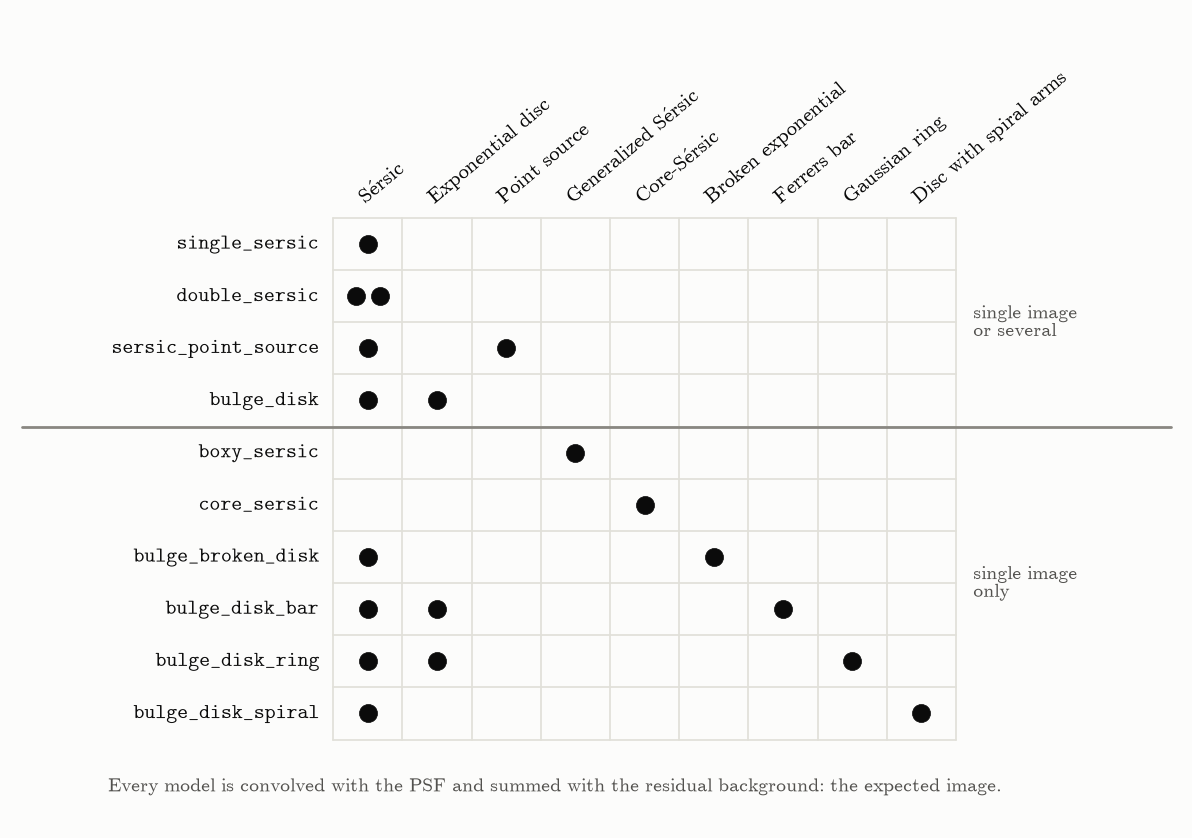
Which components each model is made of, and how every model becomes an expected image.
Conventions
These conventions hold for every model.
- Coordinates. Positions are in pixels of the prepared cutout. The
pixel with index
[j, i]is centred at(x, y) = (i, j)and coversx − 0.5tox + 0.5; scientific coordinates are written(x, y), NumPy arrays are indexed[y, x]. The default priors ofx0andy0are centred on the target seed, transformed to cutout coordinates. - Radii.
reis the half-light radius measured along the major axis, in pixels. - Axis ratio.
q = b / a, with0 < q ≤ 1. - Position angle.
thetais the angle of the major axis, in radians, measured from the+xaxis towards+y. It has period π, and it is undefined for a round component,q = 1. - Flux.
fluxis the total flux of the continuous component over the full plane, in the units of the image. A finite image holds only the part of it that falls inside the image.
Choosing models
The models to fit are listed in fit.models; each is fitted in its own fit
directory. Every flux needs a declared prior, and the other parameters have
the default priors of the
Configuration reference.
fit.comparison.enabled computes the Bayes factor of double_sersic over
single_sersic, and requires that fit.models lists exactly these two.
BayMorph ranks models; it never selects one for the user.