Bulge, Disc and Ring (bulge_disk_ring)
A Sérsic bulge, an exponential disc and an elliptical ring with a Gaussian radial profile (Gaussian ring), sharing a centre. Available for fits of a single image.
Definition
the bulge and the disc of bulge_disk and the ring of
Imfit (Erwin 2015),
on ellipses of elliptical radius \(m\) and axis ratio \(q_r\). The crest lies at the semi-major radius \(r\) and \(\sigma\) is the width along the major axis. The flux of the ring is
The ring has its own axis ratio and position angle, so it may be intrinsically elliptical or lie in another plane than the disc.
Parameters
| Parameter | Meaning | Units | Default prior |
|---|---|---|---|
flux_bulge |
total flux of the bulge | image units | none: must be declared |
re_bulge |
half-light radius of the bulge | pixels | uniform 1 to 30 |
n_bulge |
Sérsic index of the bulge | uniform 1.5 to 6 | |
q_bulge |
axis ratio of the bulge | uniform 0.4 to 1 | |
theta_bulge |
position angle of the bulge | radians | uniform −π/2 to π/2 |
flux_disk |
total flux of the disc | image units | none: must be declared |
re_disk |
half-light radius of the disc | pixels | uniform 10 to 120 |
q_disk |
axis ratio of the disc | uniform 0.4 to 1 | |
theta_disk |
position angle of the disc | radians | uniform −π/2 to π/2 |
flux_ring |
total flux of the ring | image units | none: must be declared |
r_ring |
semi-major radius of the crest of the ring | pixels | uniform 5 to 200 |
sigma_ring |
width of the ring along its major axis | pixels | uniform 2 to 20 |
q_ring |
axis ratio of the ring | uniform 0.5 to 1 | |
theta_ring |
position angle of the ring | radians | uniform −π/2 to π/2 |
x0, y0 |
shared centre | pixels | uniform ±8 about the target seed |
The default priors are generic and in pixels; they must be checked against
the target and the image. sigma_ring must be at least 2 px and q_ring at
least 0.5: the domain in which the rendering of the ring is validated, which
configuration validation enforces.
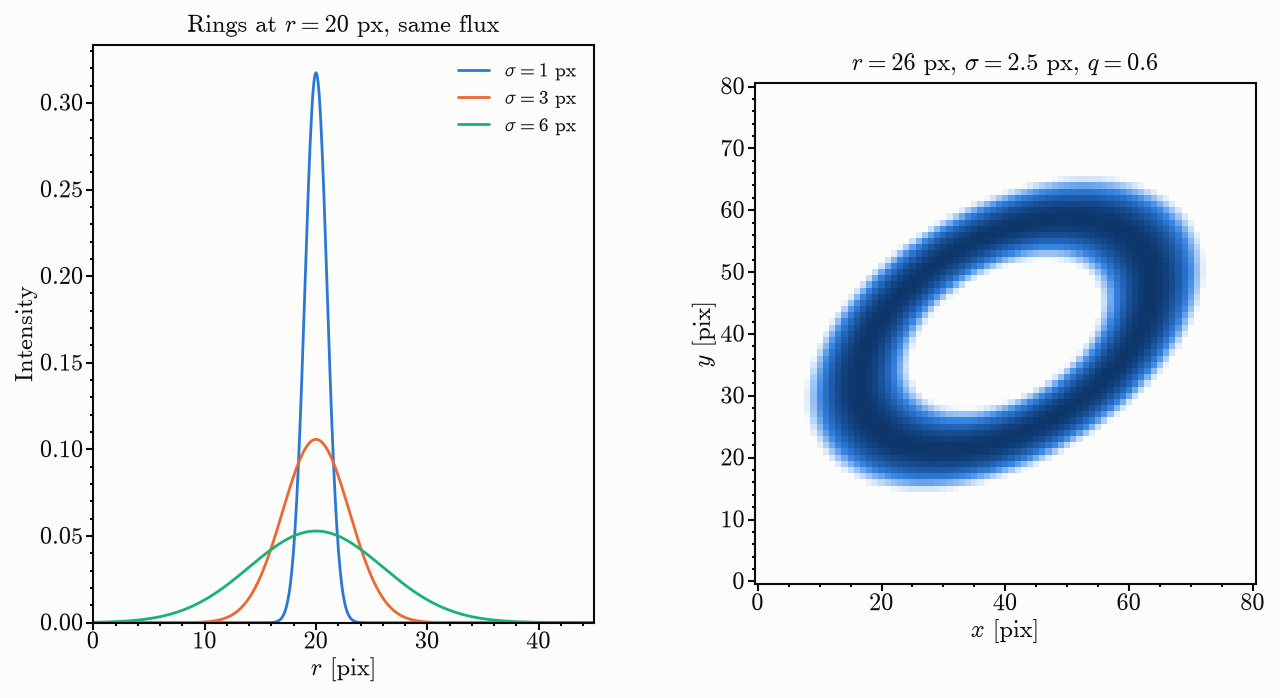
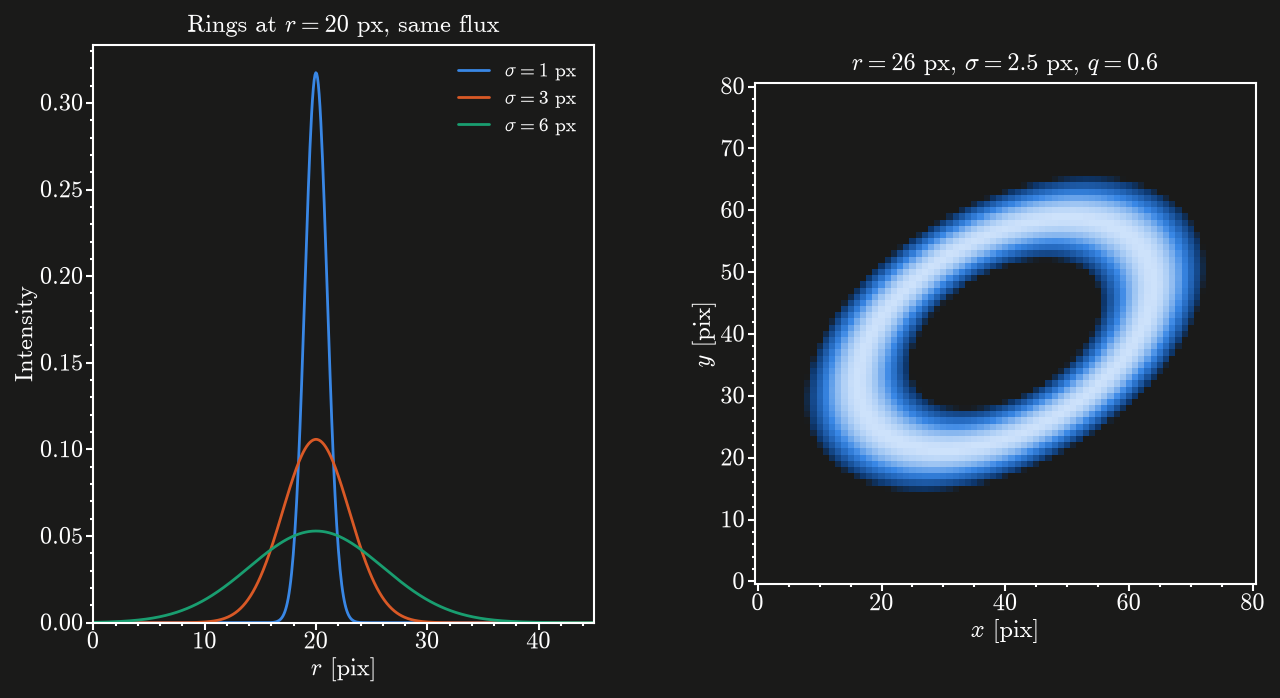
Left: rings at r = 20 px with the same flux and σ of 1, 3 and 6 px, along the major axis; a wider ring has a lower crest. Right: a ring with r = 26 px, σ = 2.5 px and q = 0.6.
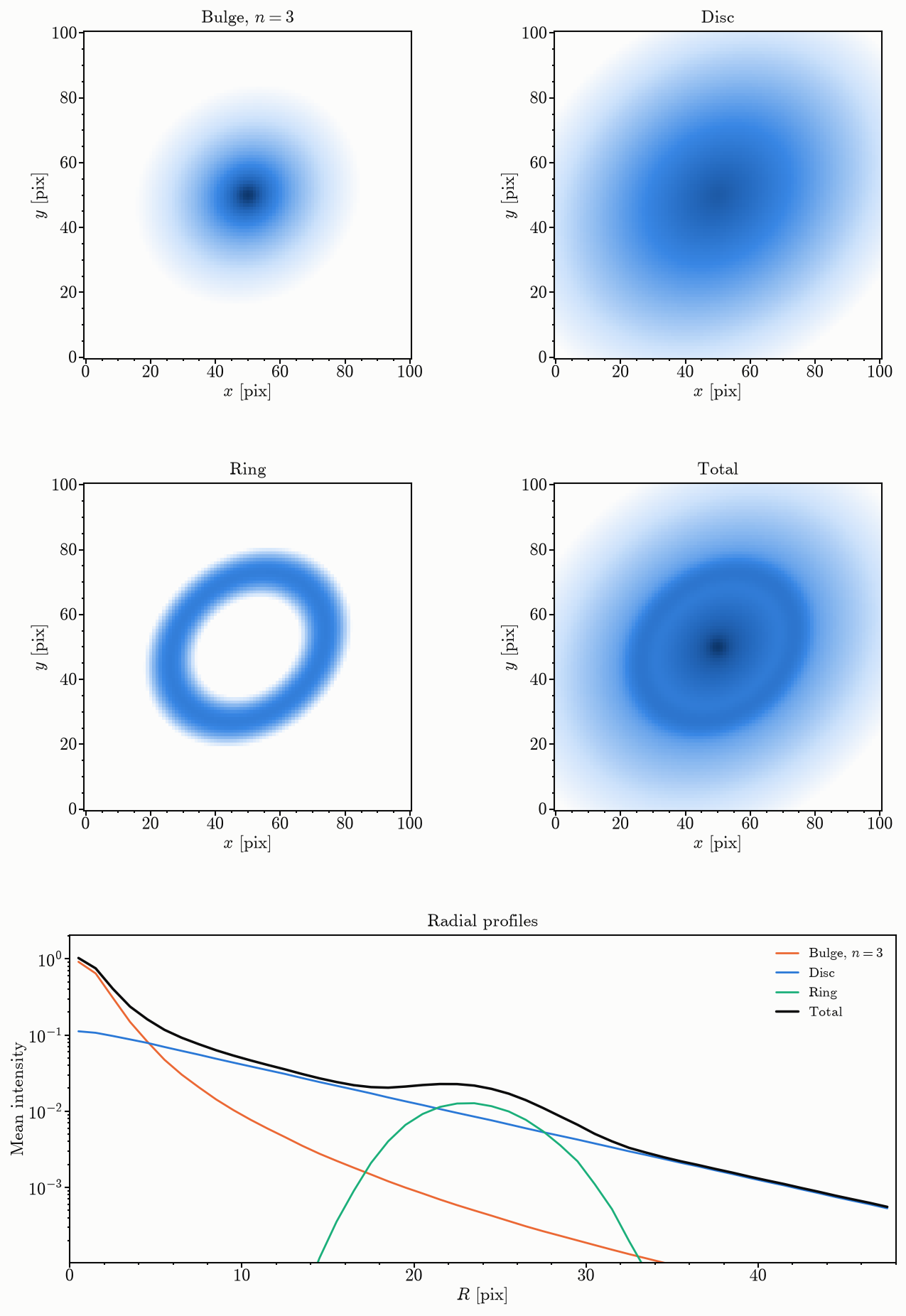
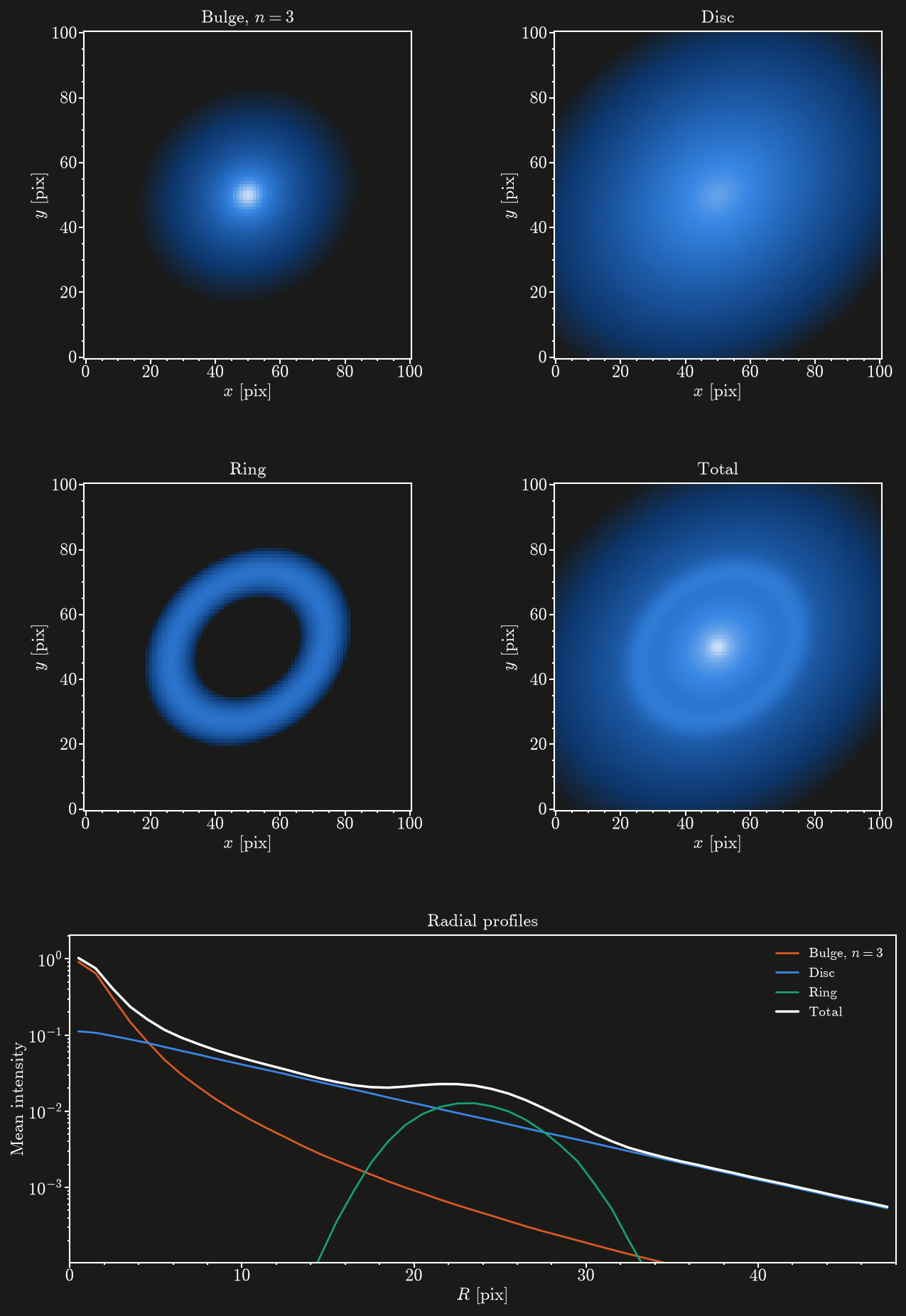
A bulge of 25 percent of the light (n = 3, Rₑ = 3 px), a disc of 60 percent (Rₑ = 16 px) and a ring of 15 percent (r = 26 px, σ = 2.5 px, q = 0.8), after a Gaussian PSF of 2.5 px FWHM. The profiles are averages over circles.
What it represents
A disc galaxy with a bulge and an inner or outer ring, or the ring-like residual that a bulge and disc decomposition leaves when the galaxy has one. Imfit (Erwin 2015) provides the same Gaussian ring for such decompositions.
Known degeneracies
- A wide ring adds light over a range of radii of the disc, so
sigma_ring,flux_ringandre_diskare correlated; a ring needs to be narrower than the disc to be told apart from it. - At low signal-to-noise,
flux_ringandsigma_ringare correlated: a faint wide ring and a fainter narrow one differ little in each pixel. q_ringandtheta_ringare free. For an intrinsically circular ring in the plane of the disc they equalq_diskandtheta_disk, which the posterior can show but the model does not impose.
Validation
- Rendering. Tested on 70 cases under PSFs of 2.3 and 3.5 px FWHM.
Every ring of
sigma_ring= 2 px or more is rendered within 1.5e-4 of the peak. Rings of 1 px far from the centre and seen atq_ring= 0.5 or less, half a pixel wide across their crest, are not rendered accurately: hence the domain above. - Deep images. The error of the ring stays far below the noise; a
compact bright bulge sets the limit, as in
bulge_broken_disk. - Flux. A ring inside the image holds its analytic flux within 1e-8.
- Recovery. On a simulated galaxy with a ring, the posterior of
r_ringandsigma_ringcovers the true values. - Cost. About a quarter more than
bulge_disk. - Real data. Not yet used on real images.
Configuration
fit:
  models:
    - bulge_disk_ring
  priors:
    bulge_disk_ring:
      flux_bulge:
        type: uniform
        lower: 1000.0
        upper: 100000.0
      flux_disk:
        type: uniform
        lower: 1000.0
        upper: 200000.0
      flux_ring:
        type: uniform
        lower: 500.0
        upper: 50000.0
Priors not declared take the defaults above; the values here are an example, to be chosen for each image. A joint fit of several images does not accept this model.
Python
baymorph.models.GaussianRingComponent is the ring;
baymorph.fitting.make_bulge_disk_ring_psf_model builds the PSF-convolved
model a fit evaluates.
References
- Erwin P., 2015, ApJ, 799, 226: the Gaussian ring.
- Freeman K. C., 1970, ApJ, 160, 811: the exponential disc.
- Sérsic J. L., 1968, Atlas de Galaxias Australes, Observatorio Astronómico, Córdoba: the Sérsic profile of the bulge.