Core-Sérsic (core_sersic)
A Sérsic profile whose centre is depleted: inside a break radius the light follows a shallow power law instead of the inward extrapolation of the Sérsic profile (Graham et al. 2003; Trujillo et al. 2004). Available for fits of a single image.
Definition
on ellipses of axis ratio \(q\), where \(R\) is the elliptical radius. Within
the break radius \(R_b\) the profile is the power law \(R^{-\gamma}\); beyond
it, the Sérsic profile of index \(n\) whose half-light radius is \(R_e\); the
transition sharpens as \(\alpha\) grows. \(b_n\) is the Sérsic constant of
index \(n\), so \(R_e\) is the half-light radius of the outer Sérsic profile;
the half-light radius of the whole profile is a derived quantity, smaller by
the light the core lacks. flux is the total flux over the whole plane, and
\(I'\) follows from it by a radial integral computed numerically.
Parameters
| Parameter | Meaning | Units | Default prior |
|---|---|---|---|
flux |
total flux of the profile | image units | none: must be declared |
re |
half-light radius of the outer Sérsic profile | pixels | uniform 1 to 120 |
n |
Sérsic index of the outer profile | uniform 0.5 to 6 | |
rb |
break radius | pixels | uniform 0.5 to 20 |
gamma |
slope of the inner power law | uniform 0 to 0.9 | |
alpha |
sharpness of the transition | uniform 0.5 to 2 | |
q |
axis ratio | uniform 0.4 to 1 | |
theta |
position angle of the major axis | radians | uniform −π/2 to π/2 |
x0, y0 |
centre | pixels | uniform ±8 about the target seed |
The default priors are generic and in pixels; they must be checked against the target and the image.
alpha. Baes (2026) finds that the deprojected density of a core-Sérsic profile is monotonic only foralphaup to a critical value, which equals 2 whengamma = 0and is never below 2. The default bound of 2 is therefore physically admissible for every core.gamma. Depleted cores have inner slopes of 0.3 or less (Dullo & Graham 2012). The bound of 0.9 is the validated domain of the rendering: steeper cusps, up to the limit of 2 at which the central flux diverges, are not resolved by the cell rules, which then raise an error.
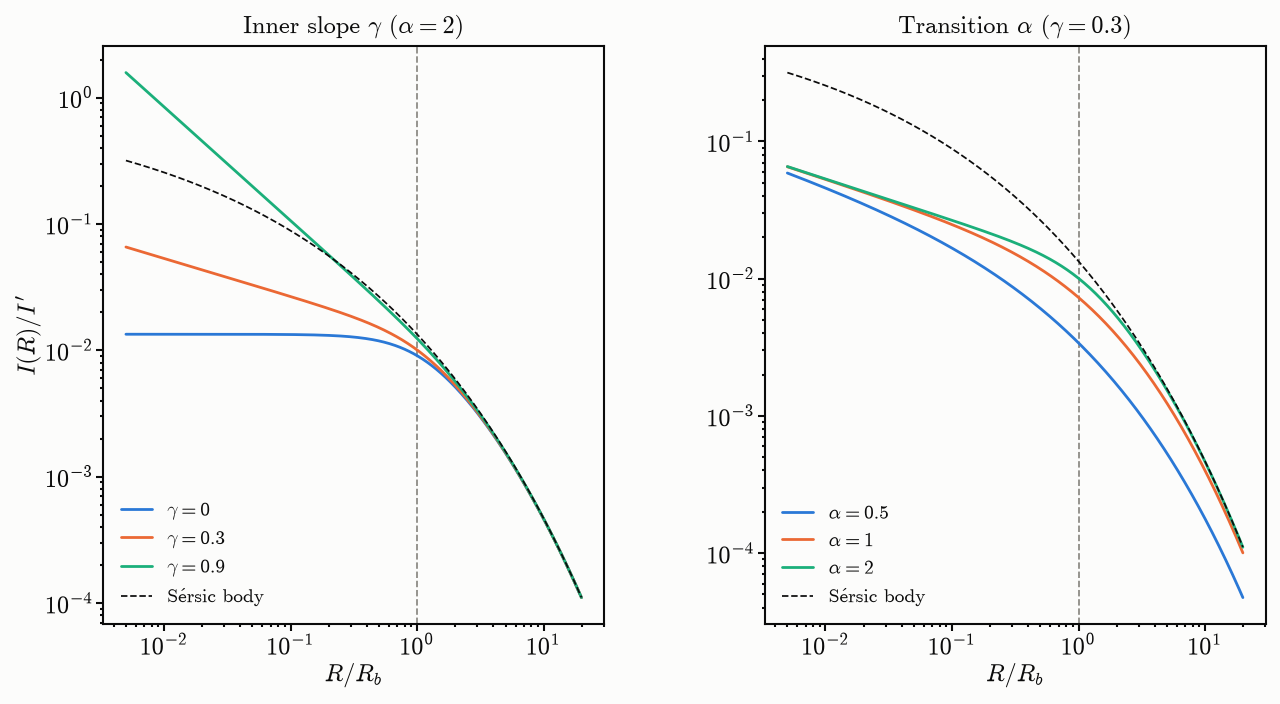
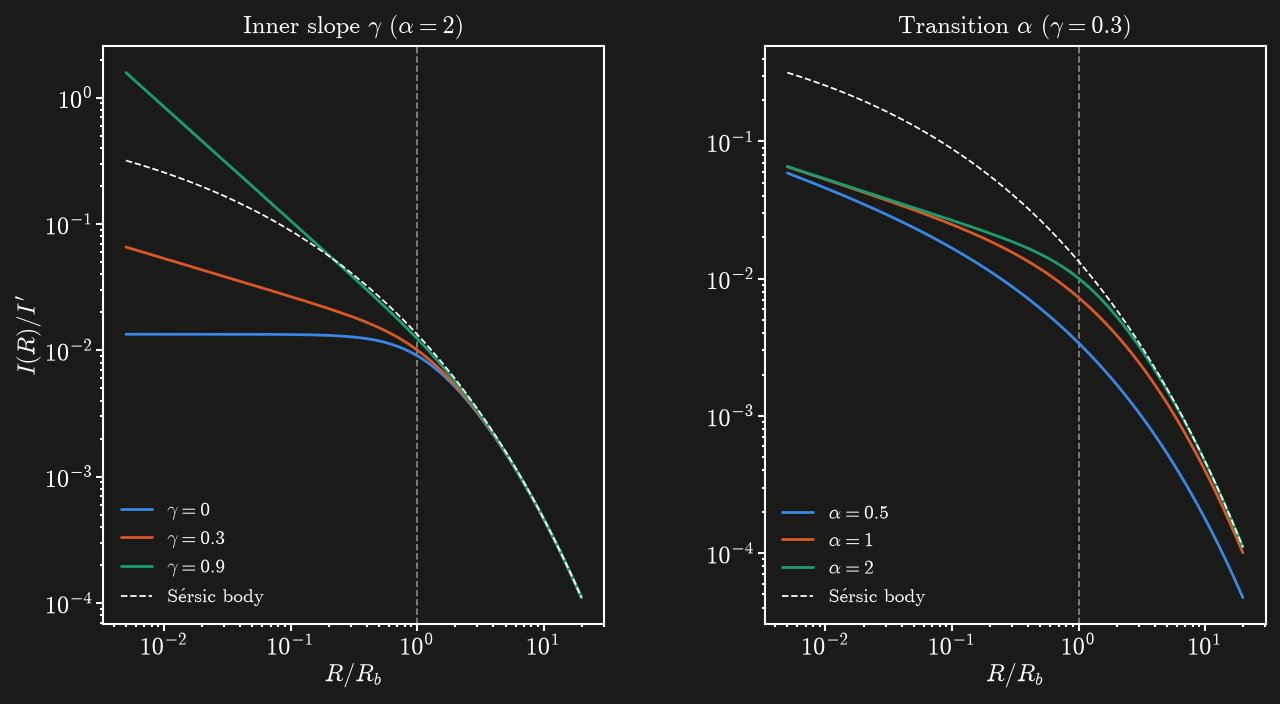
The core-Sérsic profile in units of \(I'\), with \(R_e\) = 20 px, n = 4 and \(R_b\) = 2 px, against the inward extrapolation of its Sérsic body (dashed). Left: the inner slope; right: the sharpness of the transition, which for small α broadens it far beyond the break radius.
What it represents
The partially depleted core of a luminous early-type galaxy, the light deficit that binary black holes are thought to scour, together with its Sérsic body. Every elliptical brighter than M_V = −21.66 in the Virgo sample of Kormendy et al. (2009) has such a core.
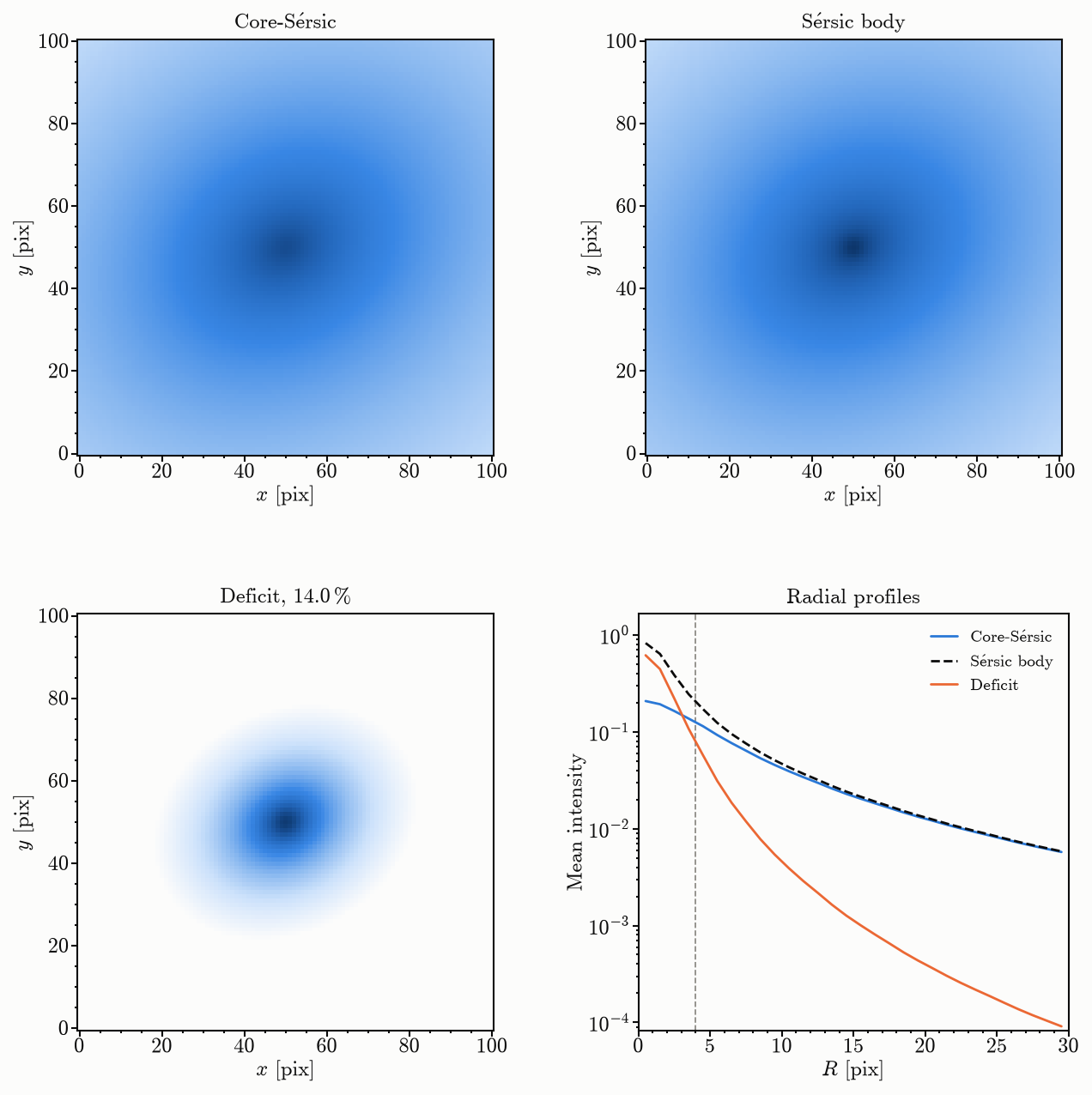
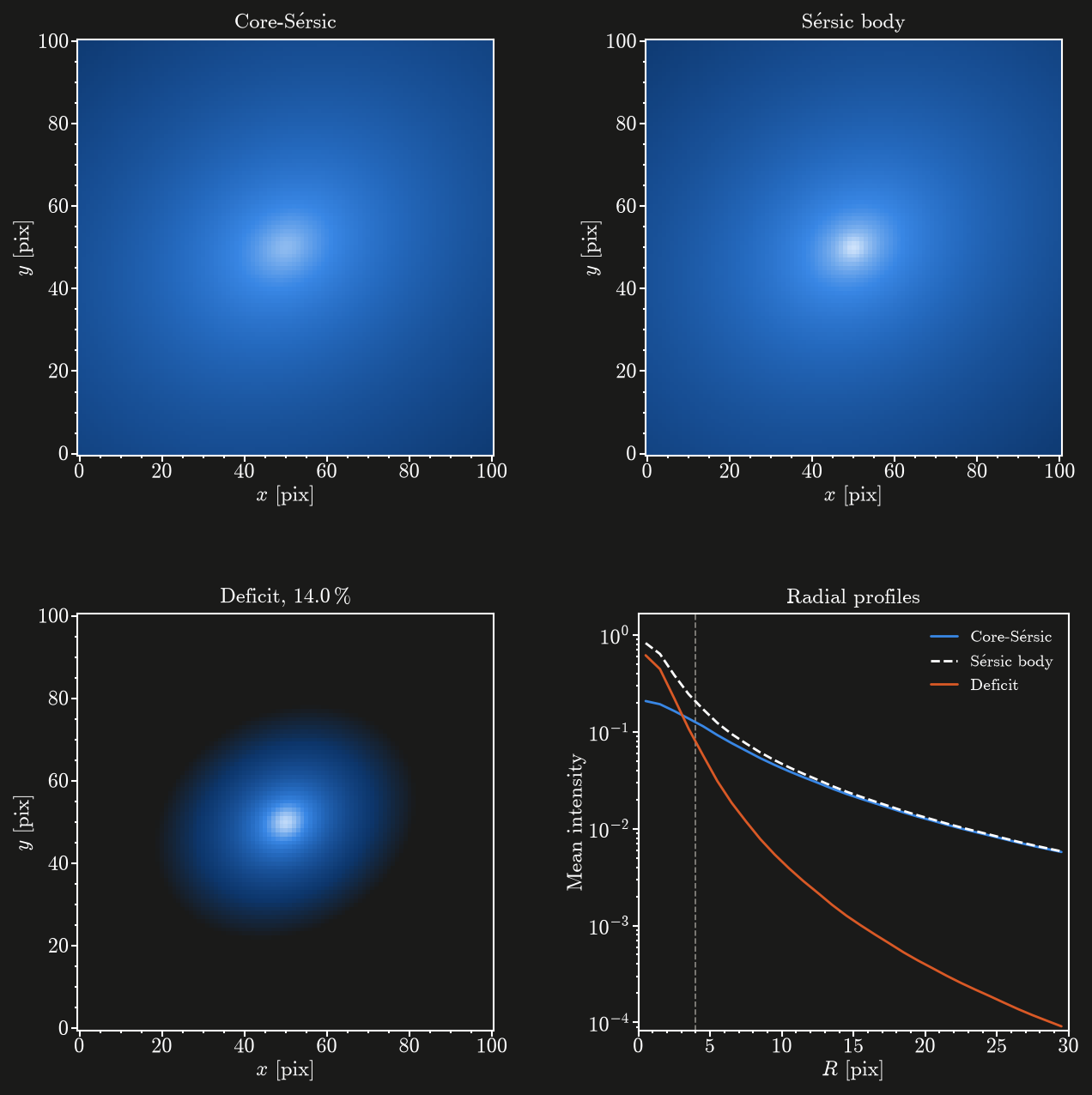
A core-Sérsic galaxy (n = 4, Rₑ = 20 px, R_b = 4 px, γ = 0.1, α = 2, q = 0.8) and its Sérsic body, the Sérsic profile it follows beyond the break, after a Gaussian PSF of 2.5 px FWHM. The core lacks 14 percent of the light of the body, within a few break radii; the vertical line marks the break radius.
Cores measure 0.02 to 0.5 kpc (Dullo 2019). A break radius
smaller than the core of the PSF is not resolved: its posterior then
follows the prior, and
an evidence comparison with single_sersic depends on that prior.
Known degeneracies
rb,gammaandalphaare strongly coupled when the break is near the resolution: a smaller core with a steeper slope and a sharper transition can match a larger, flatter and smoother one.reandndescribe the outer profile, and keep the degeneracies ofsingle_sersic.thetahas period π and is undefined forq = 1.
Validation
- Rendering. Tested on 102 cases with
rbfrom 0.5 to 5 px,gammafrom 0 to 0.9,alphafrom 0.5 to 2 andnof 4 and 6, under PSFs of 2.3 and 3.5 px FWHM: the largest pixel error is 5e-4 of the peak. - Flux. The normalization agrees with an independent radial integral within 1e-9.
- Recovery. On a simulated image whose core is resolved, the posterior
of
rbandgammacovers the true values. - Cost. About twice the cost of
single_sersic. - Real data. Not yet used on real images.
Configuration
fit:
  models:
    - core_sersic
  priors:
    core_sersic:
      flux:
        type: uniform
        lower: 1000.0
        upper: 100000.0
      rb:
        type: uniform
        lower: 0.5
        upper: 10.0
Priors not declared take the defaults above; the values here are an example, to be chosen for each image. A joint fit of several images does not accept this model.
Python
baymorph.models.CoreSersicComponent is the intrinsic profile;
baymorph.fitting.make_core_sersic_psf_model builds the PSF-convolved
model a fit evaluates.
References
- Baes M., 2026, A&A, 709, A24: the physical limit on α.
- Dullo B. T., 2019, ApJ, 886, 80: the sizes of depleted cores.
- Dullo B. T., Graham A. W., 2012, ApJ, 755, 163: the inner slopes of depleted cores.
- Graham A. W. et al., 2003, AJ, 125, 2951: the core-Sérsic profile.
- Kormendy J. et al., 2009, ApJS, 182, 216: the cores of Virgo ellipticals.
- Trujillo I. et al., 2004, AJ, 127, 1917: the core-Sérsic profile.