Bulge, Disc and Spiral Arms (bulge_disk_spiral)
A Sérsic bulge and an exponential disc with two logarithmic spiral arms (spiral disc), sharing a centre. Available for fits of a single image.
Definition
the bulge of bulge_disk and its exponential disc
\(I_d\) modulated by two arms,
where \(R\) and \(\varphi\) are the radius and the azimuth in the plane of the disc, deprojected with \(q_d\) and \(\theta_d\). The crests of the arms follow \(\varphi = \varphi_0 + w \ln(R/R_{e,d})\) modulo \(\pi\): \(w = \cot\psi\) for the pitch angle \(\psi\), and \(\varphi_0\) is the azimuth of an arm at \(R_{e,d}\), where the arms are best measured, which keeps \(\varphi_0\) and \(w\) nearly uncorrelated. The amplitude fades toward the centre, where the phase diverges, over the radius \(r_{\mathrm{in}}\).
The arms are the logarithmic-spiral mode with two arms that the two-dimensional Fourier analyses of Puerari & Dottori (1992) and Davis et al. (2012) measure on images of spiral galaxies. GALFIT (Peng et al. 2010) draws logarithmic arms differently, by rotating the coordinates of a component. The fading \(A(R)\) toward the centre is a choice of BayMorph.
The cosine integrates to zero over every ellipse, so the disc holds the
flux \(F_d\) exactly, and it is non-negative for \(0 \le A_0 \le 1\). The model
without arms, \(A_0 = 0\), is bulge_disk, which it then
reproduces bit for bit.
Sense of winding. The azimuth runs from the major axis toward the \(+\)minor direction, which is counter-clockwise on the detector with \(x\) to the right and \(y\) up. For \(w > 0\) the arms wind counter-clockwise outward and draw a Z; for \(w < 0\) they draw an S. On an image displayed with \(y\) down, or on a detector with inverted parity, the two letters swap.
Parameters
| Parameter | Meaning | Units | Default prior |
|---|---|---|---|
flux_bulge |
total flux of the bulge | image units | none: must be declared |
re_bulge |
half-light radius of the bulge | pixels | uniform 1 to 30 |
n_bulge |
Sérsic index of the bulge | uniform 1.5 to 6 | |
q_bulge |
axis ratio of the bulge | uniform 0.4 to 1 | |
theta_bulge |
position angle of the bulge | radians | uniform −π/2 to π/2 |
flux_disk |
total flux of the disc, arms included | image units | none: must be declared |
re_disk |
half-light radius of the disc | pixels | uniform 10 to 120 |
q_disk |
axis ratio of the disc | uniform 0.4 to 1 | |
theta_disk |
position angle of the disc | radians | uniform −π/2 to π/2 |
amplitude_spiral |
relative amplitude \(A_0\) of the arms | uniform 0 to 1 | |
winding_spiral |
\(w = \cot\psi\): positive for a Z, negative for an S | uniform −6 to 6 | |
phase_spiral |
azimuth \(\varphi_0\) of an arm at re_disk, in the plane of the disc |
radians | uniform 0 to π |
r_in_spiral |
radius over which the arms fade toward the centre | pixels | uniform 1 to 60 |
x0, y0 |
shared centre | pixels | uniform ±8 about the target seed |
The default priors are generic and in pixels; they must be checked against
the target and the image. winding_spiral must lie between −6 and 6, pitch
angles of at least 9.5°, and re_disk, q_disk and r_in_spiral must be
at least 10 px, 0.4 and 1 px: the domain in which the rendering of the arms
is validated, which configuration validation enforces. The pitch angle
\(\psi = \operatorname{arccot} |w|\) is a derived quantity: under the uniform
prior in \(w\), half of the prior mass lies at pitch angles below 18.4°.
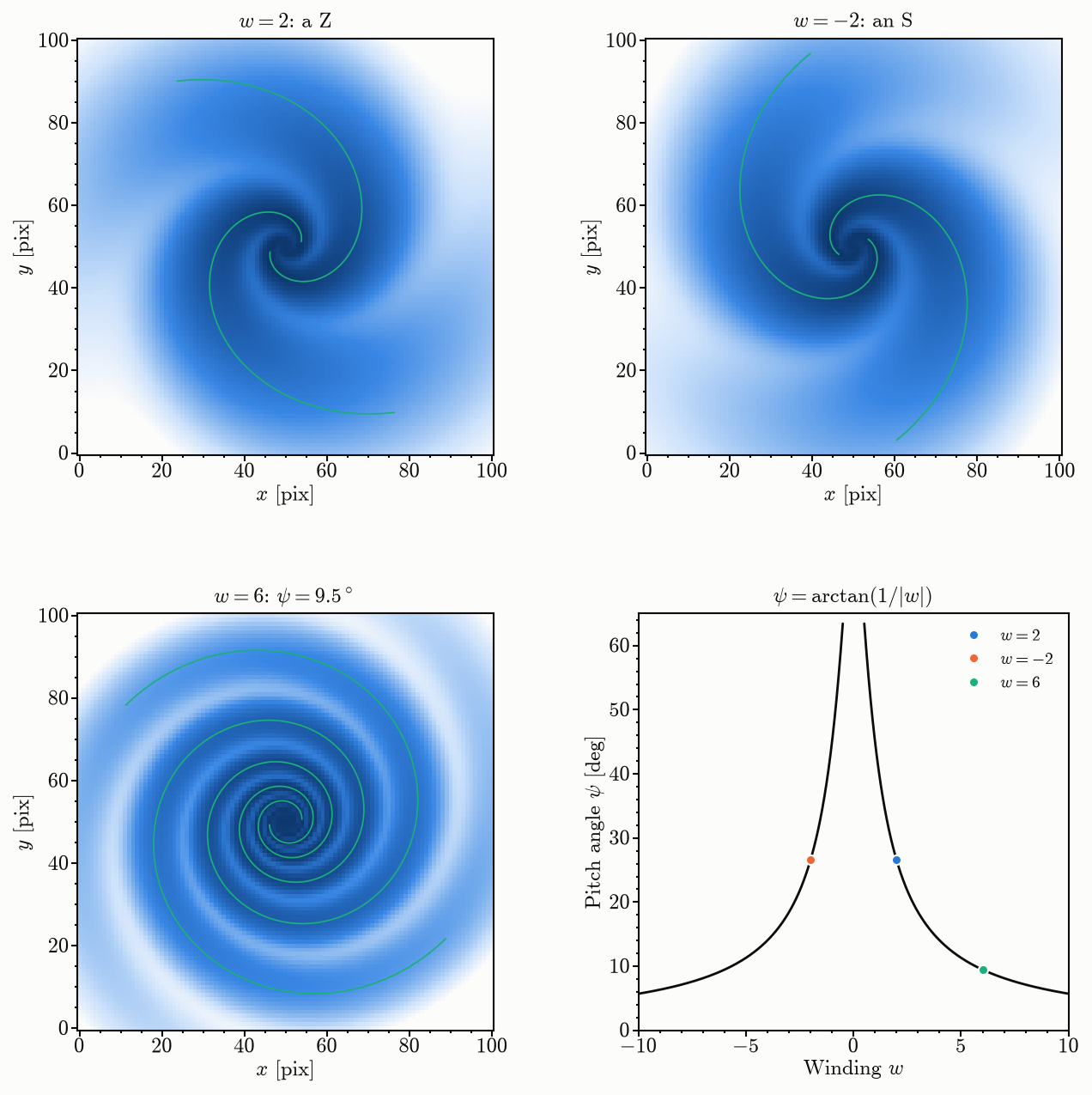
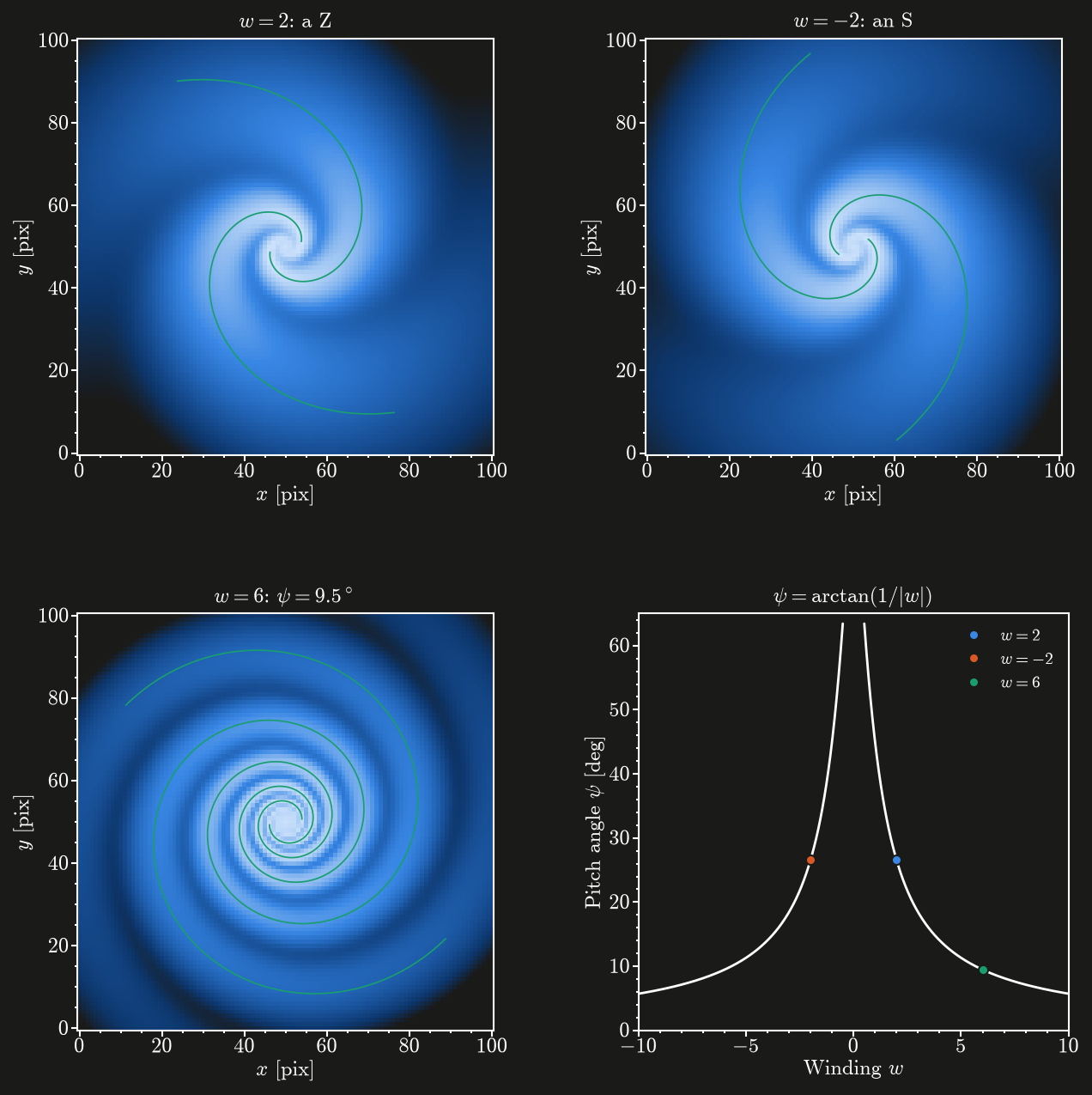
Face-on discs with R_e = 20 px, A₀ = 0.7, φ₀ = 0.4 and r_in = 4 px, shown with x to the right and y up. The lines are the crests φ = φ₀ + w ln(R/R_e) of the two arms. The last panel gives the pitch angle of the arms, ψ = arctan(1/|w|), against the winding.
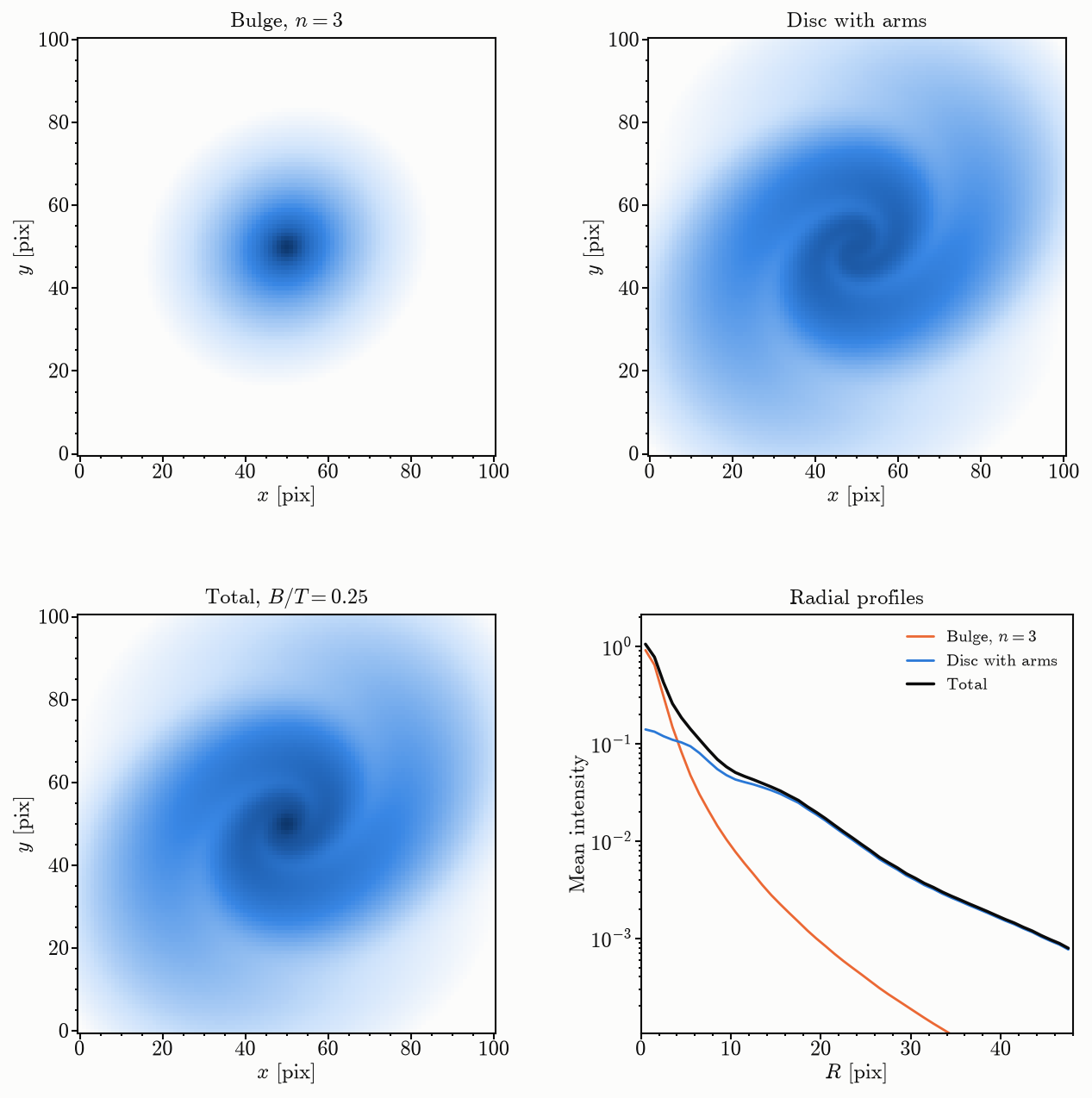
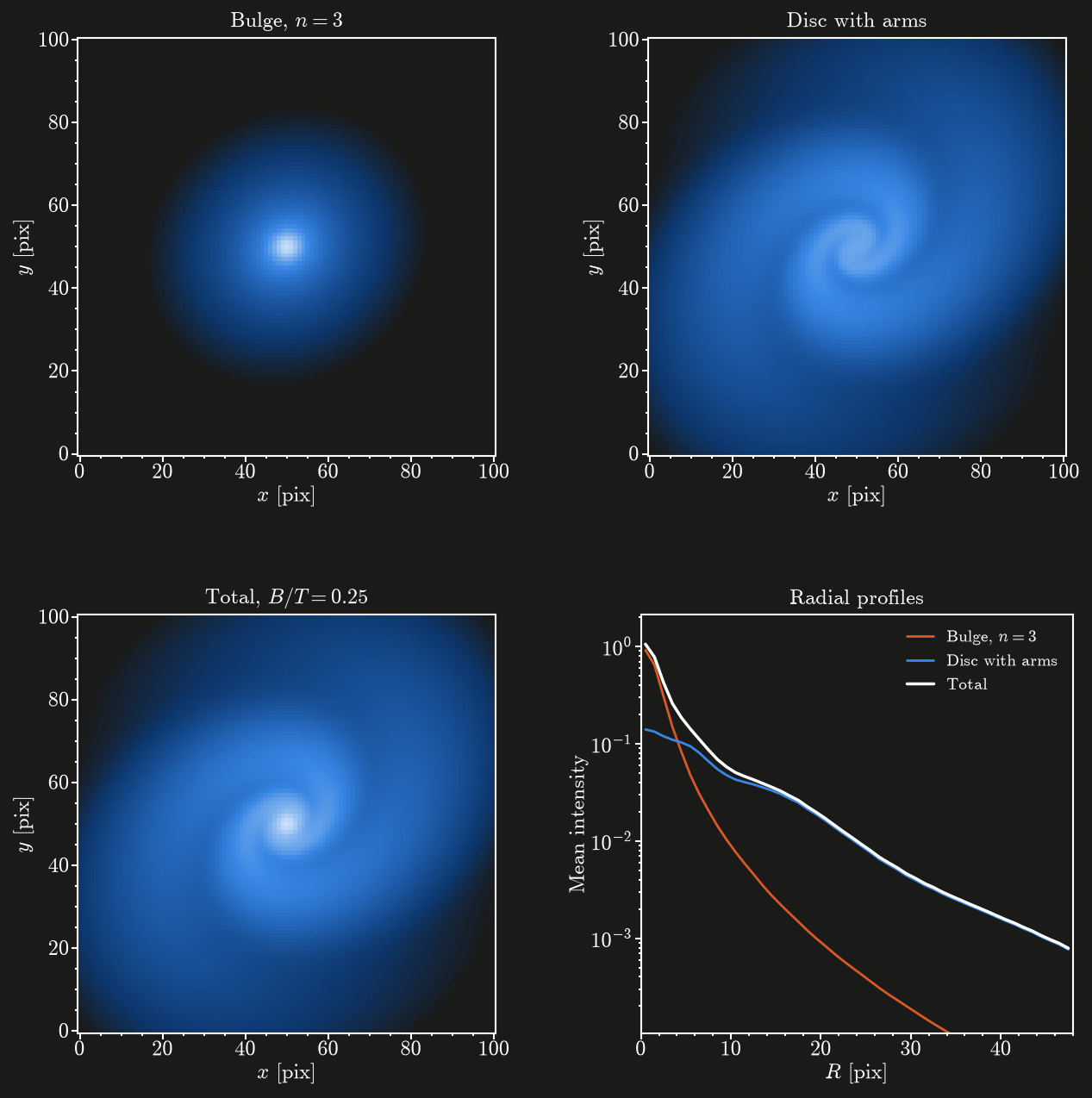
A bulge of 25 percent of the light (n = 3, Rₑ = 3 px) and a disc of 75 percent (Rₑ = 16 px, q = 0.8) with arms of A₀ = 0.6 and w = 2.5, after a Gaussian PSF of 2.5 px FWHM. Averaged over circles, the arms vanish from the profile of the disc.
What it represents
A spiral galaxy with a bulge and two arms, described as a density wave on its disc. The posterior of the pitch angle comes from a forward model with the PSF and the noise, jointly with the bulge and the disc. The pitch angle correlates with the mass of the central black hole (Seigar et al. 2008; Davis, Graham & Seigar 2017) and with the Hubble type (Kennicutt 1981).
Real arms are not exact logarithmic spirals: their pitch varies from arm to arm (Lingard et al. 2021), and flocculent arms, dust lanes and star-forming regions, strongest in blue bands, leave residuals this model does not describe.
Known degeneracies
- At low signal-to-noise
amplitude_spiralandwinding_spiralare correlated: faint arms constrain their winding poorly. r_in_spiralandamplitude_spiralboth set the light of the arms in the inner disc.phase_spiralis periodic with period π. A posterior that straddles 0 and π is split between the two ends of its prior, and the summaries of the package, which are not circular, then misreport it, as they would a position angle near ±π/2.- The bulge and the inner disc share the light at small radii, as in
bulge_disk.
Validation
- Rendering. Tested on 182 cases under PSFs of 2.3 and 3.5 px FWHM, with windings up to |w| = 11.4, a pitch angle of 5°, and axis ratios of 0.6 and 0.4. Within the domain above the largest pixel error is 2.0e-3 of the peak and the largest flux error 9.3e-6.
- Arms near the centre. Where the arms wind faster than a pixel, near the centre, the rendering integrates them adaptively; the largest error there is 8e-7 of the peak of the arms.
- Deep images. The disc with its arms stays below the noise; a compact
bright bulge sets the limit, as in
bulge_broken_disk. - Flux. The arms integrate to zero within 1e-8 of the flux of the disc,
and with
amplitude_spiral= 0 the model is exactlybulge_disk. - Sense of winding. w > 0 winds counter-clockwise outward on the detector, drawing a Z; w < 0 winds clockwise, drawing an S.
- Recovery. On a simulated spiral galaxy, the posterior of
winding_spiralandphase_spiralcovers the true values. - Cost. Two to three times the cost of
bulge_disk. - Real data. Not yet used on real images.
Configuration
fit:
  models:
    - bulge_disk_spiral
  priors:
    bulge_disk_spiral:
      flux_bulge:
        type: uniform
        lower: 1000.0
        upper: 100000.0
      flux_disk:
        type: uniform
        lower: 1000.0
        upper: 200000.0
Priors not declared take the defaults above; the values here are an example, to be chosen for each image. A joint fit of several images does not accept this model.
Python
baymorph.models.LogSpiralDiskComponent is the disc with its arms;
baymorph.fitting.make_bulge_disk_spiral_psf_model builds the
PSF-convolved model a fit evaluates.
References
- Davis B. L., Graham A. W., Seigar M. S., 2017, MNRAS, 471, 2187: the pitch angle and the black-hole mass.
- Davis B. L. et al., 2012, ApJS, 199, 33: logarithmic-spiral modes and the pitch angle.
- Freeman K. C., 1970, ApJ, 160, 811: the exponential disc.
- Kennicutt R. C., 1981, AJ, 86, 1847: the pitch angle along the Hubble sequence.
- Lingard T. et al., 2021, MNRAS, 504, 3364: the variation of pitch between arms.
- Peng C. Y. et al., 2010, AJ, 139, 2097: logarithmic arms by a rotation of coordinates.
- Puerari I., Dottori H. A., 1992, A&AS, 93, 469: logarithmic-spiral modes of spiral galaxies.
- Seigar M. S. et al., 2008, ApJ, 678, L93: the pitch angle and the black-hole mass.
- Sérsic J. L., 1968, Atlas de Galaxias Australes, Observatorio Astronómico, Córdoba: the Sérsic profile of the bulge.