Double Sérsic (double_sersic)
Two Sérsic profiles with a shared centre, each with its own flux, radius, index, axis ratio and position angle.
Definition
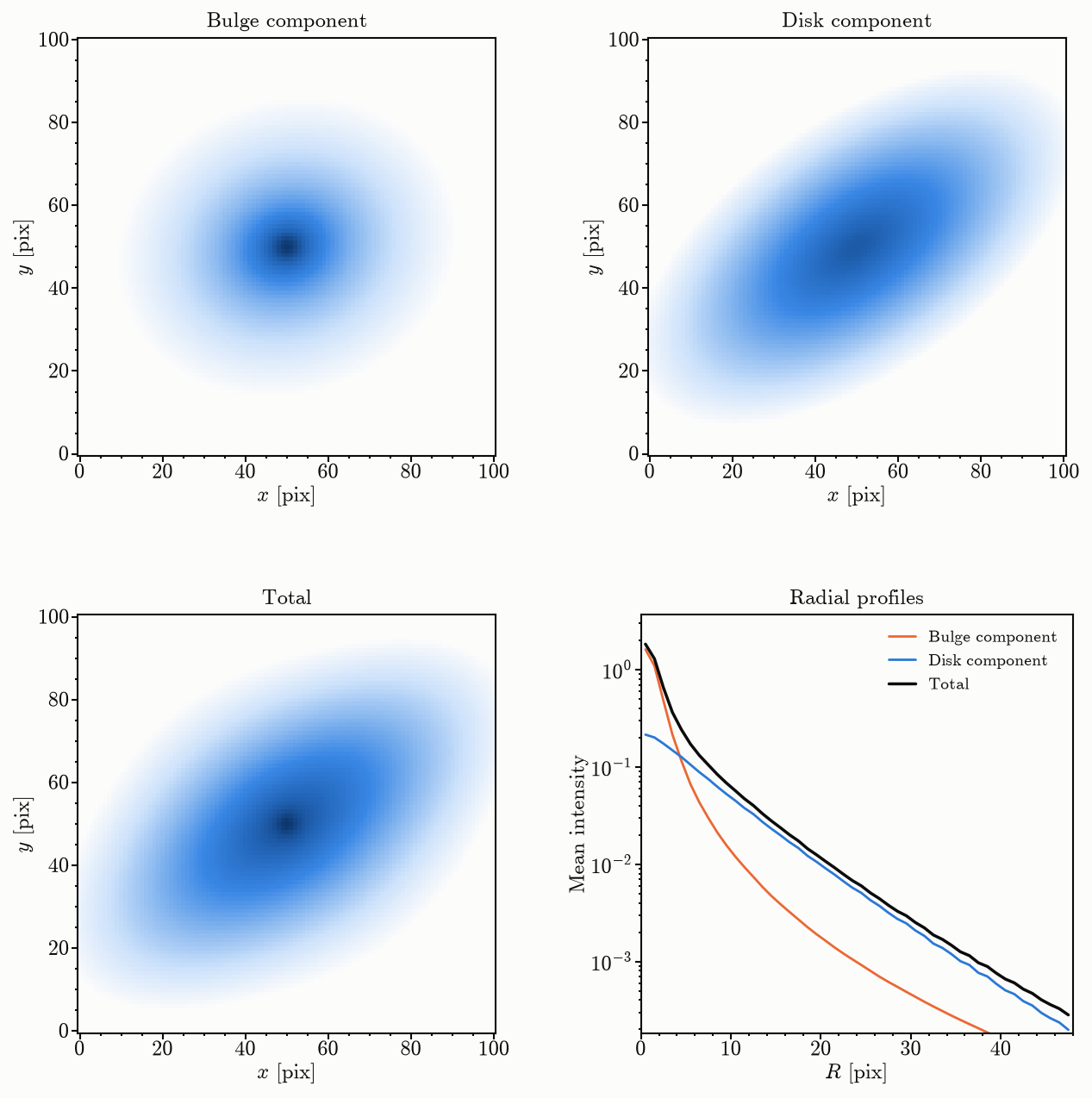
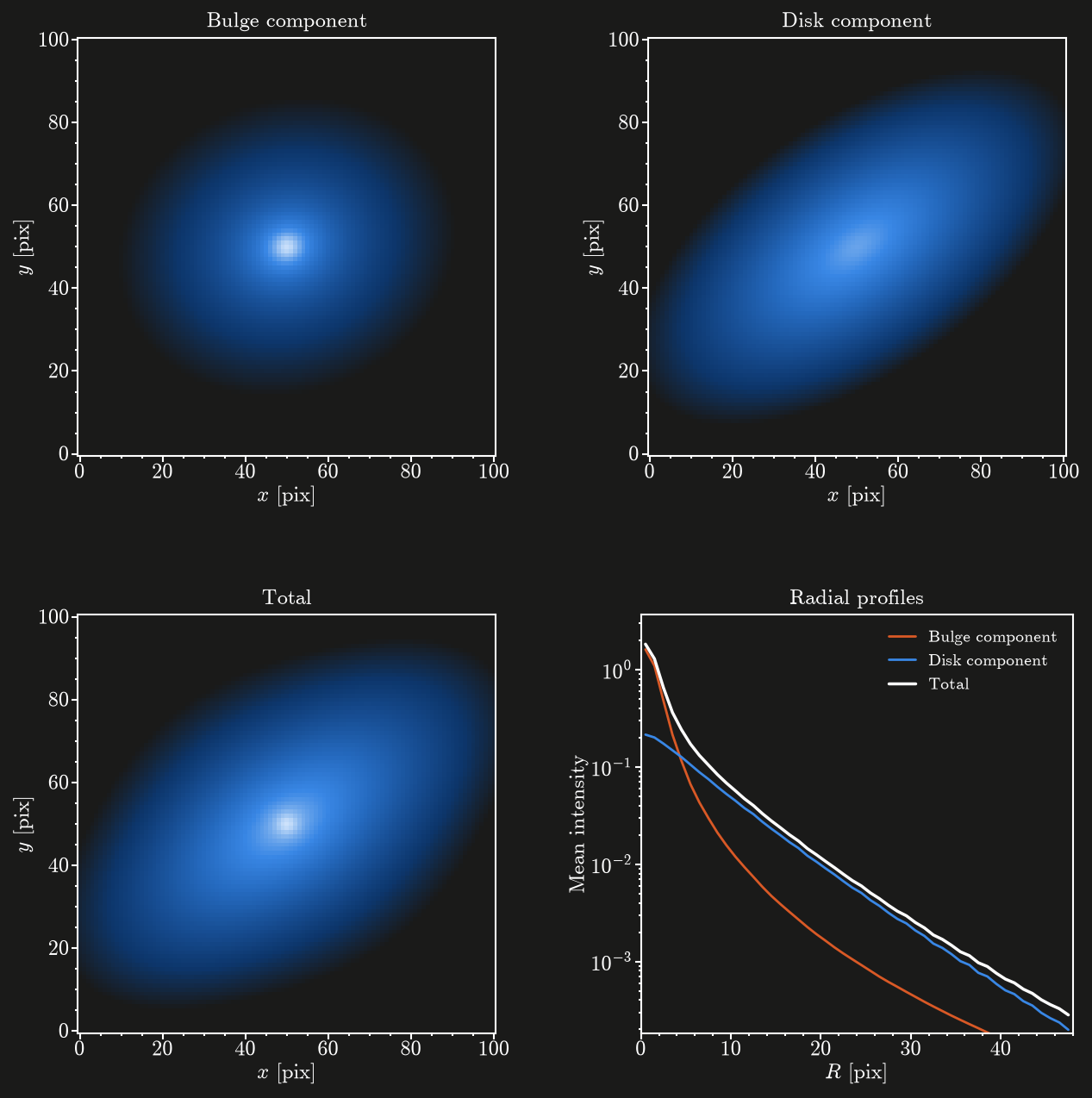
The two labelled components, a compact one of index 4 and an extended one of index 1, and their sum after a Gaussian PSF of 2.5 px FWHM; the last panel gives the mean intensity in circular annuli.
Parameters
| Parameter | Meaning | Units | Default prior |
|---|---|---|---|
flux_bulge |
total flux of the first component | image units | none: must be declared |
re_bulge |
its half-light radius | pixels | uniform 1 to 30 |
n_bulge |
its Sérsic index | uniform 1.5 to 6 | |
q_bulge |
its axis ratio | uniform 0.4 to 1, from the q default |
|
theta_bulge |
its position angle | radians | uniform −π/2 to π/2, from the theta default |
flux_disk |
total flux of the second component | image units | none: must be declared |
re_disk |
its half-light radius | pixels | uniform 10 to 120 |
n_disk |
its Sérsic index | uniform 0.5 to 3 | |
q_disk |
its axis ratio | uniform 0.4 to 1, from the q default |
|
theta_disk |
its position angle | radians | uniform −π/2 to π/2, from the theta default |
x0, y0 |
shared centre | pixels | uniform ±8 about the target seed |
A prior declared under q or theta applies to both components unless a
component-specific prior is declared; the two components keep separate
parameters.
What it represents
Two general Sérsic components of one galaxy, sharing a centre, fitted at
once as GALFIT fits several components (Peng et al. 2002);
Dullo & Graham (2014) caution against more Sérsic
components than the structure of a galaxy warrants. The names
bulge and disk are labels of the components, defined by their different
default priors, a compact component of higher index and an extended one of
lower index; the model does not impose a physical bulge and disc
decomposition, since both components are general Sérsic profiles with free
indices. For a Sérsic bulge with an exponential disc, use
bulge_disk. The components share their centre, not their
shape.
Known degeneracies
- Where the priors of the two components overlap, for example radii between 10 and 30 px and indices between 1.5 and 3, the posterior has modes related by exchanging the labels.
- The split of the flux between the components is correlated with their radii and indices, and the posterior is far from Gaussian: a mixture of Student-t distributions about its modes matches it poorly. Its evidence therefore relies on a nested sampler such as Nautilus.
- Each component inherits the degeneracies of the single Sérsic.
Validation
- Rendering. The model renders as the exact sum of its two components, with the rendering of the single Sérsic.
- Very deep images. Under an empirical PSF the model is rendered with an error comparable with the noise once one of its components passes its own limit, usually the compact, steeper one: a component of n = 4 and Rₑ of 2 to 5 px reaches it at a peak signal-to-noise of 7e3 to 1.6e4, one of n = 6 and Rₑ = 1 px at 1.2e3.
- Model comparison. With
fit.comparison.enabled, BayMorph computes the Bayes factor ofdouble_sersicoversingle_sersicon the same prepared data, mask and likelihood. - Recovery and calibration. No dedicated recovery or calibration campaign has been run for this model.
Configuration
fit:
  models:
    - single_sersic
    - double_sersic
  comparison:
    enabled: true
  priors:
    double_sersic:
      flux_bulge:
        type: uniform
        lower: 100.0
        upper: 50000.0
      flux_disk:
        type: uniform
        lower: 100.0
        upper: 100000.0
The flux prior of single_sersic must be declared as well; see
Single Sérsic.
Python
baymorph.DoubleSersicModel(bulge, disk) combines two SersicModel
components; baymorph.fitting.make_double_sersic_psf_model builds the
PSF-convolved model a fit evaluates.
References
- Dullo B. T., Graham A. W., 2014, MNRAS, 444, 2700: the caution against excessive multiple Sérsic components.
- Graham A. W., Driver S. P., 2005, PASA, 22, 118: the total flux of each component.
- Peng C. Y. et al., 2002, AJ, 124, 266: the simultaneous fit of several components.
- Sérsic J. L., 1963, Boletín de la Asociación Argentina de Astronomía, 6, 41: the Sérsic profile of each component.
- Sérsic J. L., 1968, Atlas de Galaxias Australes, Observatorio Astronómico, Córdoba: the Sérsic profile of each component.