Bulge and Broken Disc (bulge_broken_disk)
A Sérsic bulge and an exponential disc whose scale length changes at a break radius (broken exponential disc), sharing a centre. Available for fits of a single image.
Definition
with the disc of Erwin, Pohlen & Beckman (2008),
an exponential of scale length \(h_{\mathrm{in}}\) inside the break radius \(r_b\) and of \(h_{\mathrm{out}}\) outside it, joined over a width \(w_b\). Erwin, Pohlen & Beckman write the sharpness \(\alpha = 1/w_b\); BayMorph uses the width, so that every disc parameter but the flux is a length. The disc is a down-bending type II for \(h_{\mathrm{out}} < h_{\mathrm{in}}\) (Freeman 1970), an up-bending type III for \(h_{\mathrm{out}} > h_{\mathrm{in}}\) (Erwin, Beckman & Pohlen 2005), and a single exponential, type I, for \(h_{\mathrm{out}} = h_{\mathrm{in}}\).
Parameters
| Parameter | Meaning | Units | Default prior |
|---|---|---|---|
flux_bulge |
total flux of the bulge | image units | none: must be declared |
re_bulge |
half-light radius of the bulge | pixels | uniform 1 to 30 |
n_bulge |
Sérsic index of the bulge | uniform 1.5 to 6 | |
q_bulge |
axis ratio of the bulge | uniform 0.4 to 1 | |
theta_bulge |
position angle of the bulge | radians | uniform −π/2 to π/2 |
flux_disk |
total flux of the disc | image units | none: must be declared |
h_in_disk |
scale length inside the break | pixels | uniform 2 to 80 |
h_out_disk |
scale length outside the break | pixels | uniform 2 to 80 |
rb_disk |
break radius | pixels | uniform 5 to 300 |
wb_disk |
width of the break | pixels | uniform 0.5 to 20 |
q_disk |
axis ratio of the disc | uniform 0.4 to 1 | |
theta_disk |
position angle of the disc | radians | uniform −π/2 to π/2 |
x0, y0 |
shared centre | pixels | uniform ±8 about the target seed |
The default priors are generic and in pixels; they must be checked against
the target and the image. wb_disk must be at least 0.5 px, the sharpest
break whose rendering is validated, which configuration validation enforces.
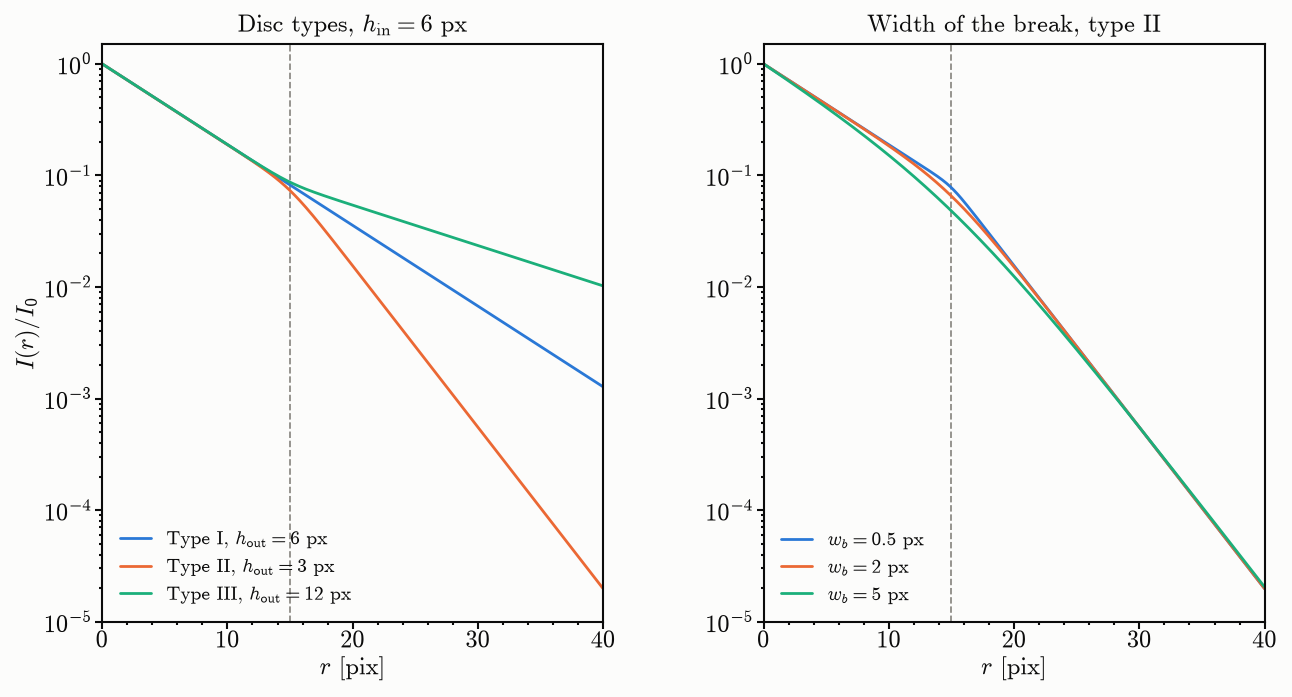
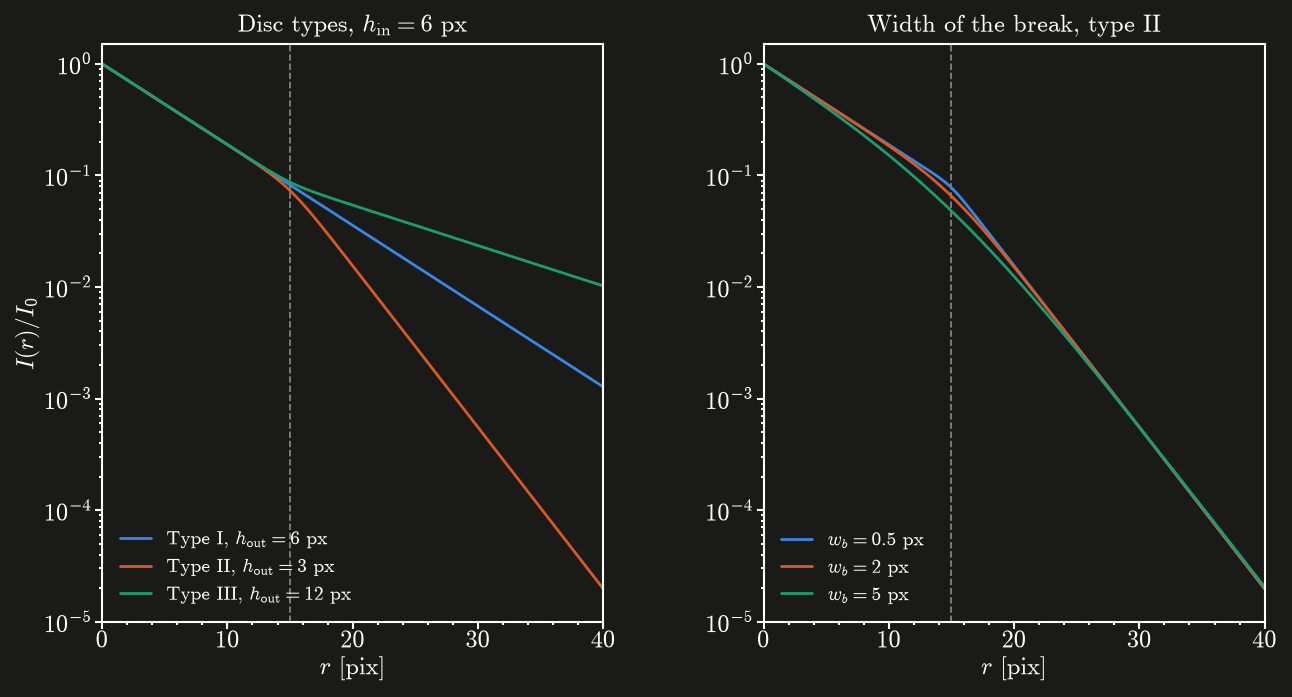
Left: discs of types I, II and III with \(h_{\mathrm{in}}\) = 6 px and a break at 15 px. Right: a type II disc with three widths of the break.
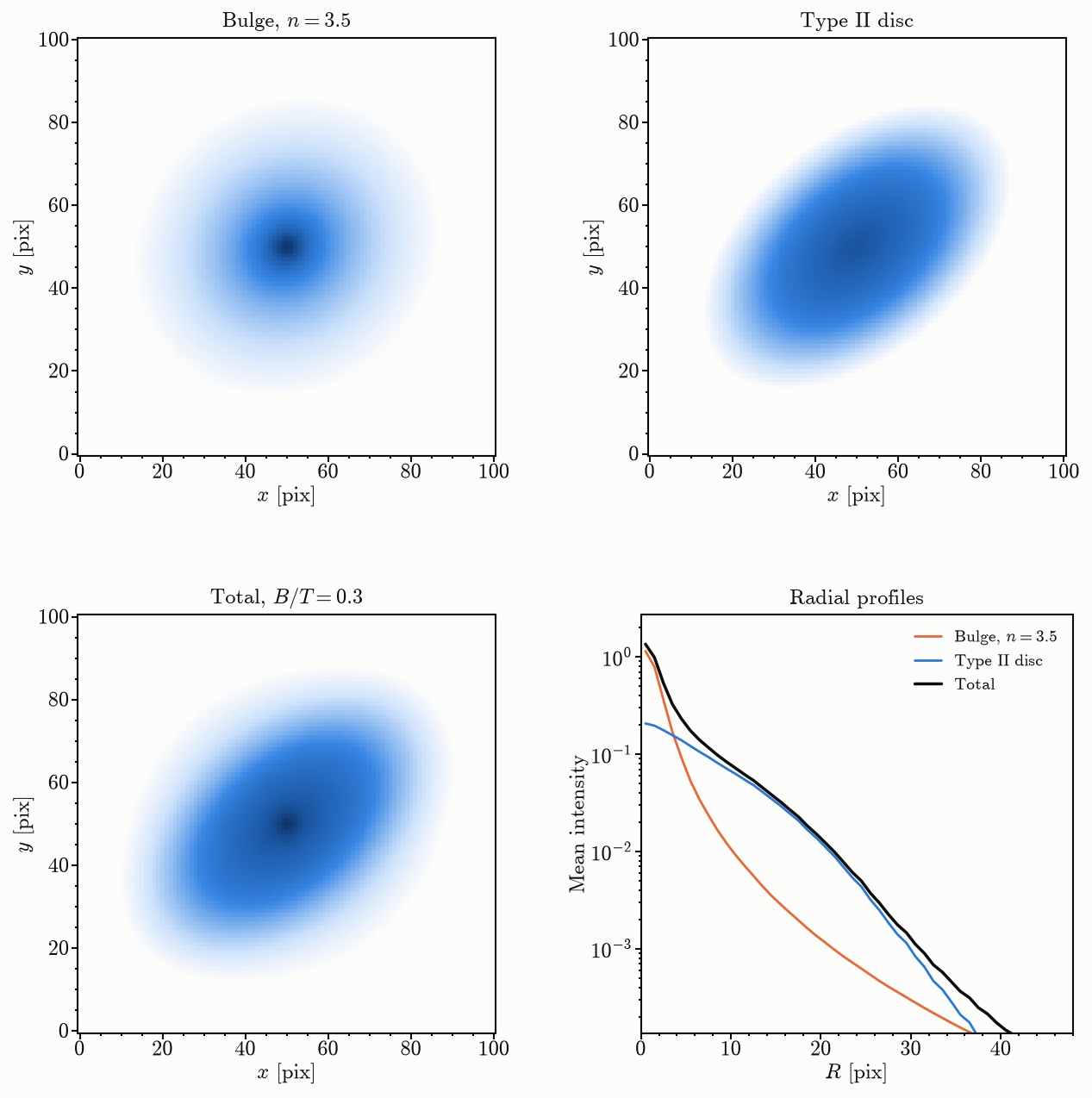
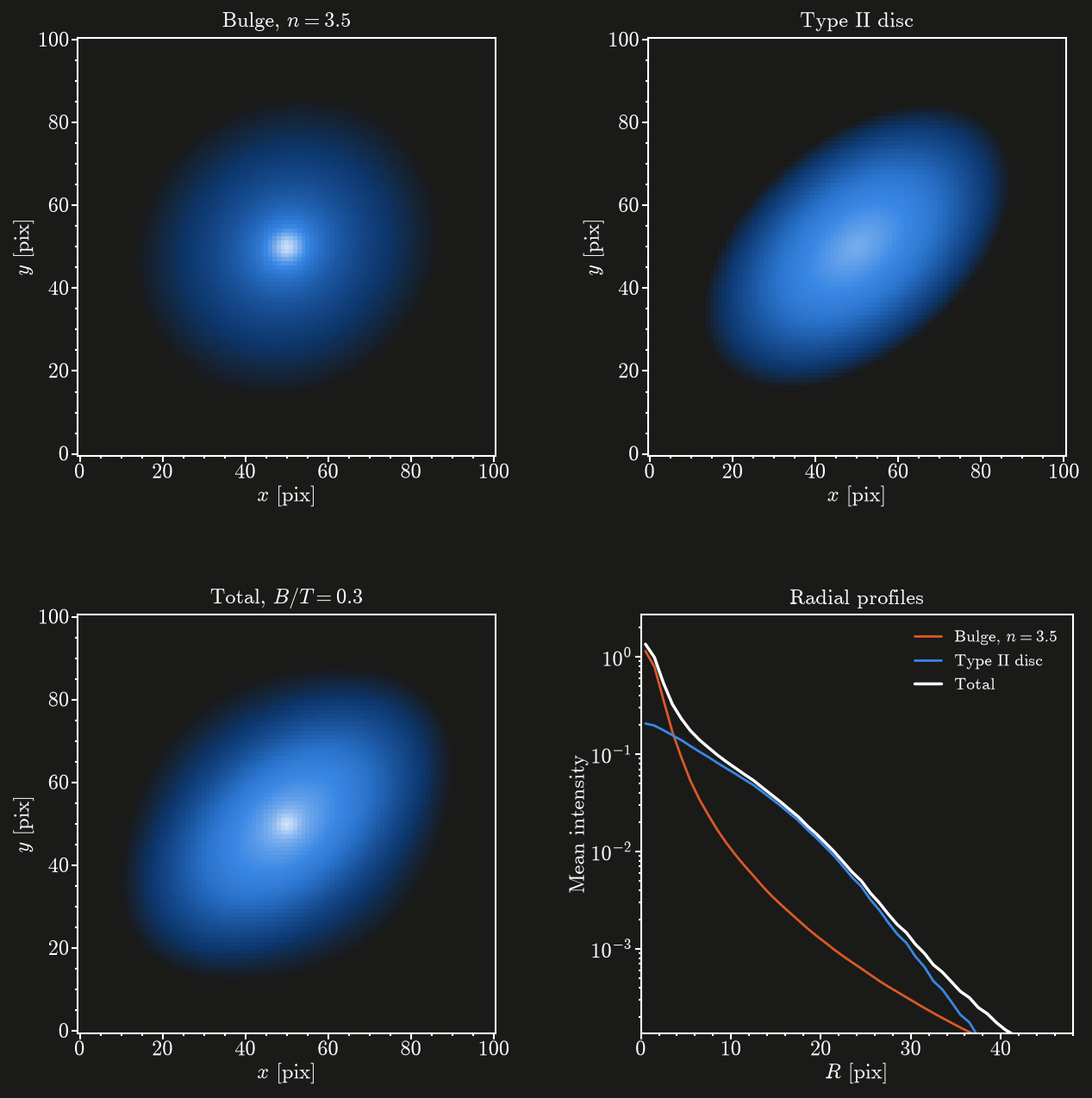
A bulge of 30 percent of the light (n = 3.5, Rₑ = 3 px) and a type II disc (\(h_{\mathrm{in}}\) = 10 px, \(h_{\mathrm{out}}\) = 4 px, break at 22 px), after a Gaussian PSF of 2.5 px FWHM. The profiles are averages over circles, so the break of the inclined disc appears smoothed.
What it represents
A bulge and a disc whose outer profile departs from a single exponential. Among the late-type spirals of Pohlen & Trujillo (2006), about 10 percent have type I profiles, 60 percent type II and 30 percent type III, and the fraction of up-bending profiles rises toward earlier types. Up-bending profiles are also found in early-type barred discs (Erwin, Beckman & Pohlen 2005). A break needs depth to be measured: it lies at a few scale lengths, where the disc is faint.
Known degeneracies
- The bulge and the inner disc share the light at small radii, as in
bulge_disk. h_out_diskand the residual background are anticorrelated, because both set the light far from the centre.rb_diskandwb_diskare correlated for broad breaks, and a break within the bulge-dominated radii is weakly constrained.- For
h_out_disknearh_in_diskthe break vanishes, andrb_diskandwb_diskfollow their priors.
Validation
- Rendering. The disc was tested on 96 cases of types II and III, with
wb_diskfrom 0.5 to 5 px, under PSFs of 2.3 and 3.5 px FWHM: the largest pixel error is 3e-5 of the peak. - Compact bright bulges. The bulge is rendered as in
bulge_disk: a compact bright bulge is rendered with an error comparable with the noise above a peak signal-to-noise of about 1.5e4. - Flux. A compact disc holds its analytic flux within 1e-8. With
h_out_diskequal toh_in_diskthe disc reproduces the exponential disc within 2.3e-7 of the peak. - Recovery. On a simulated type II disc with a bulge, the posterior of
h_out_diskandrb_diskcovers the true values. - Cost. About a quarter more than
bulge_disk. - Real data. Not yet used on real images.
Configuration
fit:
  models:
    - bulge_broken_disk
  priors:
    bulge_broken_disk:
      flux_bulge:
        type: uniform
        lower: 1000.0
        upper: 100000.0
      flux_disk:
        type: uniform
        lower: 1000.0
        upper: 200000.0
Priors not declared take the defaults above; the values here are an example, to be chosen for each image. A joint fit of several images does not accept this model.
Python
baymorph.models.BrokenExponentialComponent is the disc;
baymorph.fitting.make_bulge_broken_disk_psf_model builds the PSF-convolved
model a fit evaluates.
References
- Erwin P., Beckman J. E., Pohlen M., 2005, ApJ, 626, L81: the type III profile.
- Erwin P., Pohlen M., Beckman J. E., 2008, AJ, 135, 20: the broken exponential disc.
- Freeman K. C., 1970, ApJ, 160, 811: the exponential disc and the type II profile.
- Pohlen M., Trujillo I., 2006, A&A, 454, 759: the frequency of the three types.
- Sérsic J. L., 1968, Atlas de Galaxias Australes, Observatorio Astronómico, Córdoba: the Sérsic profile of the bulge.