Bulge and Disc (bulge_disk)
A Sérsic bulge and an exponential disc with a shared centre: the classical bulge and disc decomposition. The disc is the exponential of Freeman (1970); the bulge is a Sérsic profile (Sérsic 1968) of free index, as in the decompositions of Andredakis, Peletier & Balcells (1995), who found the index of bulges to fall from early to late types.
Definition
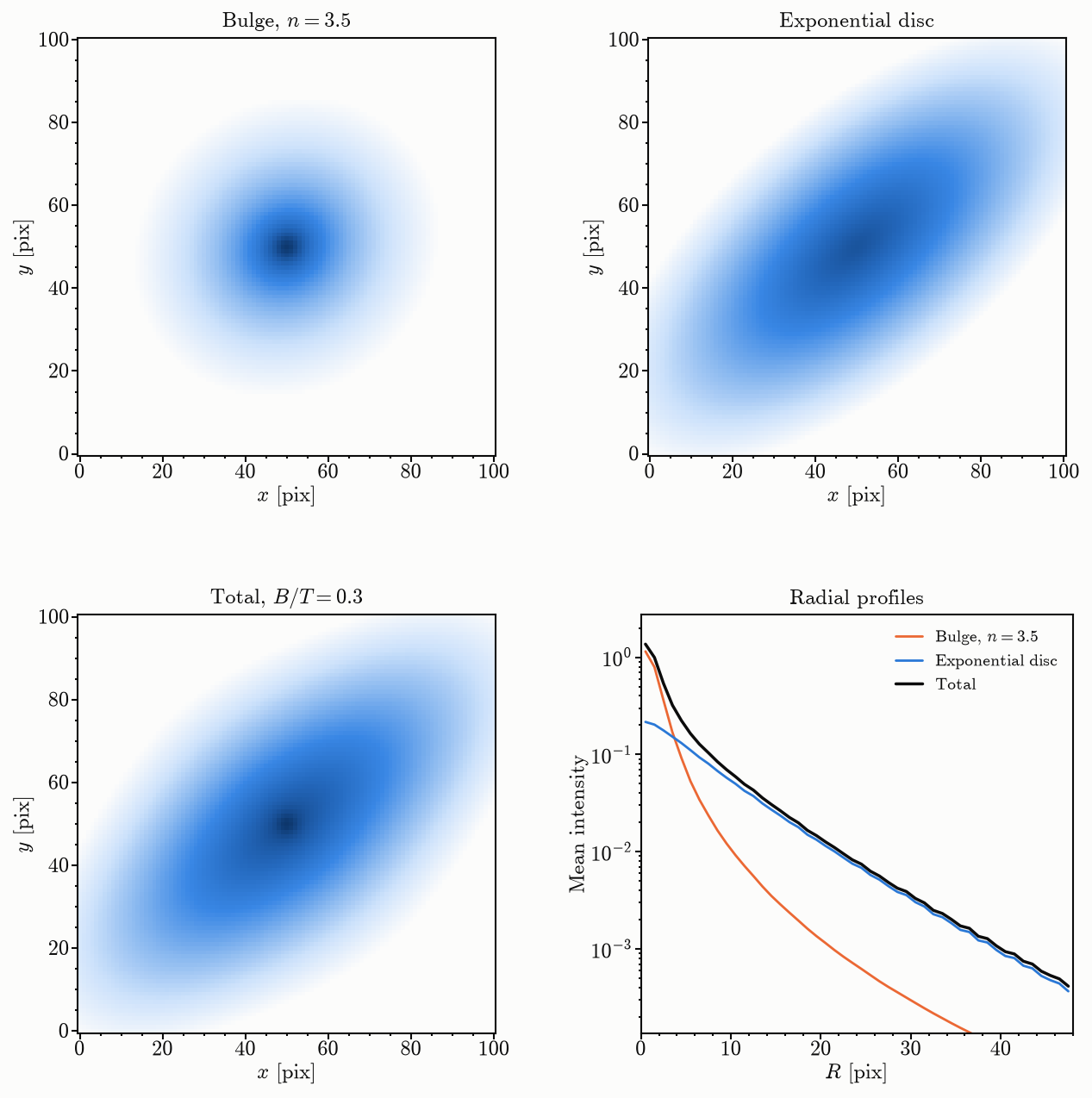
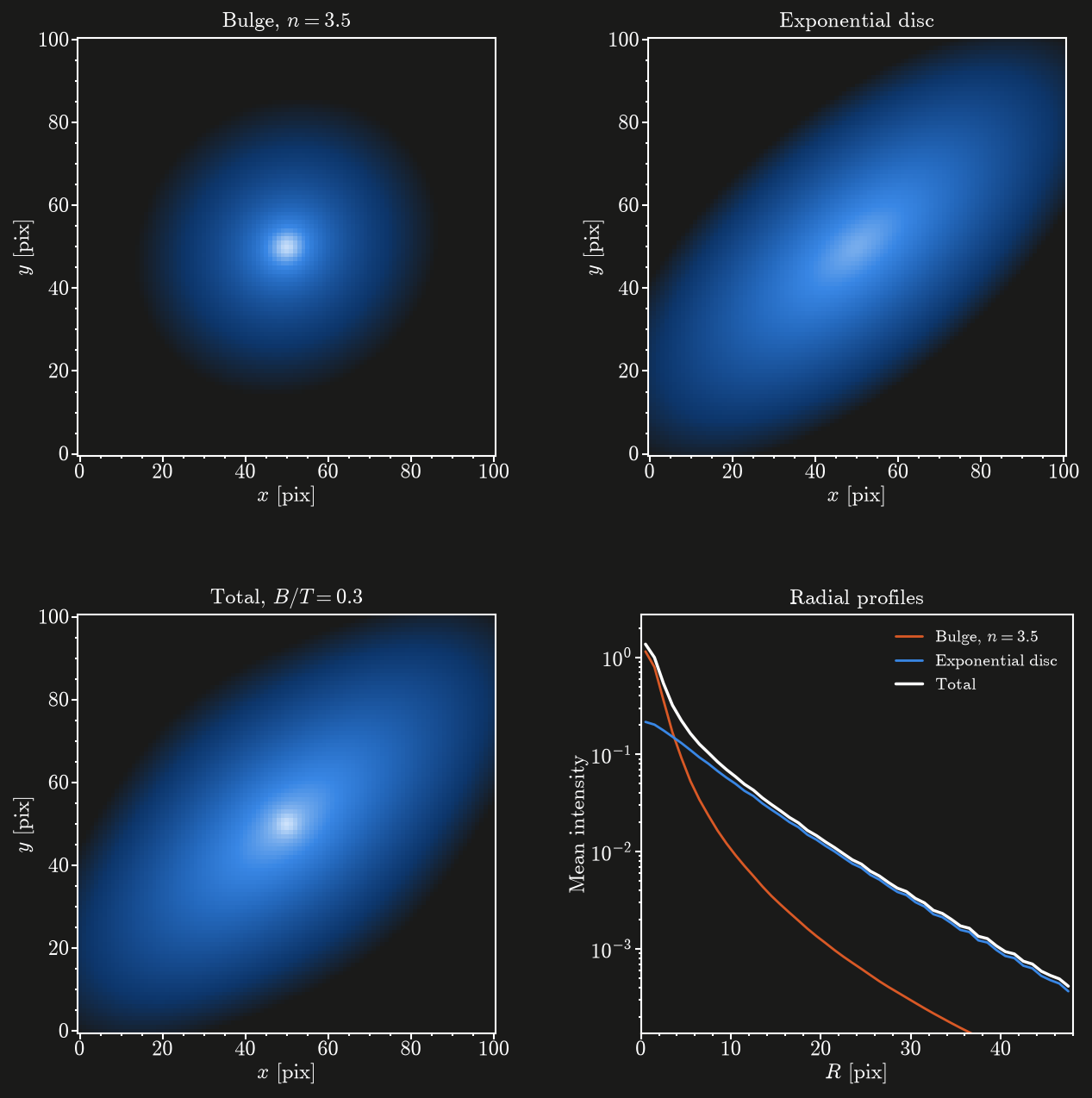
A bulge of index 3.5 and an exponential disc with a bulge-to-total ratio of 0.3, after a Gaussian PSF of 2.5 px FWHM: the bulge dominates the centre, the disc the outskirts.
Parameters
| Parameter | Meaning | Units | Default prior |
|---|---|---|---|
flux_bulge |
total flux of the bulge | image units | none: must be declared |
re_bulge |
half-light radius of the bulge | pixels | uniform 1 to 30 |
n_bulge |
Sérsic index of the bulge | uniform 1.5 to 6 | |
q_bulge |
axis ratio of the bulge | uniform 0.4 to 1 | |
theta_bulge |
position angle of the bulge | radians | uniform −π/2 to π/2 |
flux_disk |
total flux of the disc | image units | none: must be declared |
re_disk |
half-light radius of the disc | pixels | uniform 10 to 120 |
q_disk |
axis ratio of the disc | uniform 0.4 to 1 | |
theta_disk |
position angle of the disc | radians | uniform −π/2 to π/2 |
x0, y0 |
shared centre | pixels | uniform ±8 about the target seed |
re_disk is the half-light radius of the disc, not its exponential scale
length, which is re_disk / 1.678. The intrinsic model also gives the total
flux and the bulge-to-total ratio (total_flux and bulge_to_total).
What it represents
A galaxy made of a spheroidal component, the bulge, with a free Sérsic
index, and a disc whose profile is exponential. Unlike
double_sersic, whose two components are general Sérsic
profiles, this model assigns a physical meaning to its components through
the fixed index of the disc. The shared centre belongs to the fitting
parameterization; the bulge and the disc keep separate axis ratios and
position angles. Bars, rings, spiral arms and a disc truncation are not
represented.
Known degeneracies
- The bulge-to-total ratio is correlated with the index and the radius of the bulge: the bulge and the disc trade light at the radii where both contribute.
- Where the radius priors overlap, between 10 and 30 px, a compact disc and an extended bulge can describe similar light.
- Each component inherits the degeneracies of the single Sérsic.
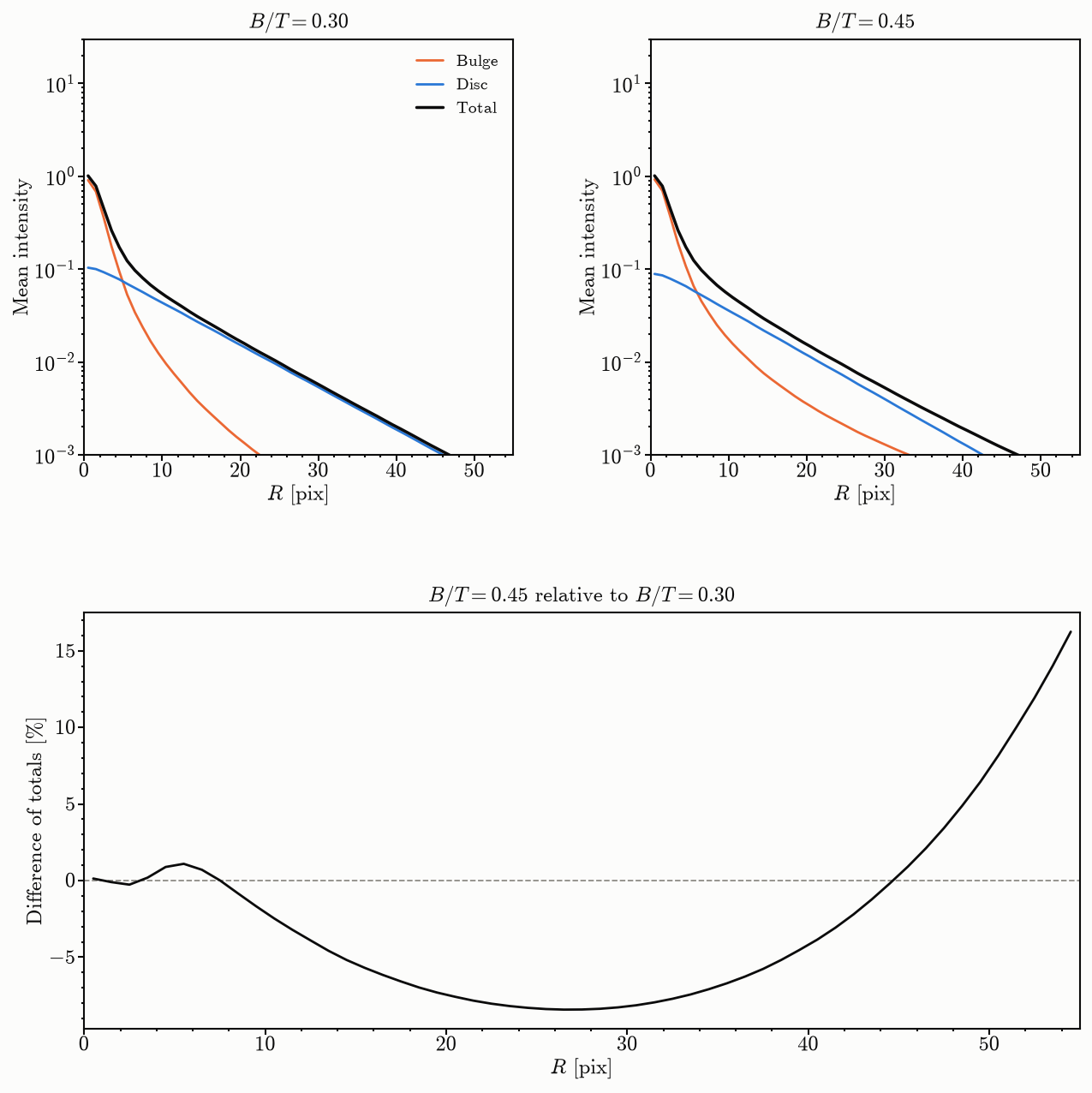
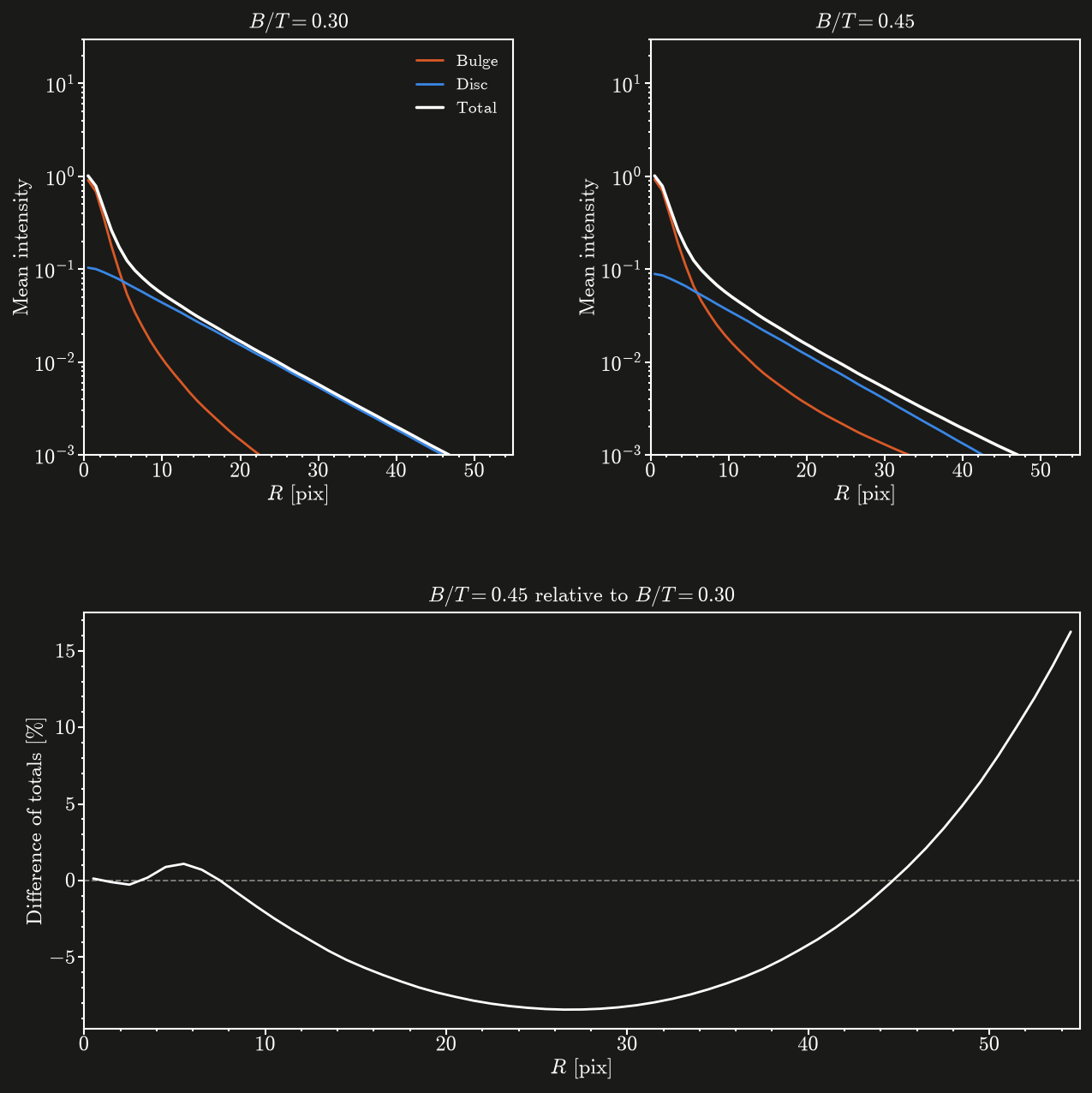
Two decompositions of nearly the same galaxy: with B/T forced from 0.30 to 0.45, the bulge and disc radii and the bulge index adjust so that the totals agree within about 1 percent inside 8 px and within 8 percent out to 45 px, while the components differ widely.
Validation
- Rendering. The model renders as the exact sum of the Sérsic bulge and the exponential disc.
- Very deep images. Under an empirical PSF the model is rendered with an error comparable with the noise once one of its components passes its own limit. A bulge of n = 4 and Rₑ of 2 to 5 px reaches it at a peak signal-to-noise of 7e3 to 1.6e4, and an exponential disc of Rₑ = 10 px at 6e3.
- Recovery. A controlled test recovers the posterior of the two fluxes of a simulated 25 x 25 px image with a Gaussian PSF, with the structural parameters fixed; the full structural recovery has not been validated.
- Calibration. No calibration campaign has been run for this model.
Configuration
fit:
  models:
    - bulge_disk
  priors:
    bulge_disk:
      flux_bulge:
        type: uniform
        lower: 100.0
        upper: 50000.0
      flux_disk:
        type: uniform
        lower: 100.0
        upper: 100000.0
Python
baymorph.models.BulgeDiskModel(bulge, disk) combines a SersicModel bulge
and an ExponentialComponent disc;
baymorph.fitting.make_bulge_disk_psf_model builds the PSF-convolved model a
fit evaluates.
References
- Andredakis Y. C., Peletier R. F., Balcells M., 1995, MNRAS, 275, 874: Sérsic bulges of free index with an exponential disc.
- Freeman K. C., 1970, ApJ, 160, 811: the exponential disc.
- Sérsic J. L., 1968, Atlas de Galaxias Australes, Observatorio Astronómico, Córdoba: the Sérsic profile of the bulge.