Sky and Background
The sky is handled in two steps. Preparation measures the sky around the galaxy and subtracts it as a constant; the fit then infers what is left, the residual background, together with the galaxy. The residual background belongs to the observation: it is not part of the galaxy, and no morphology model contains it.
The sky in preparation
prepare_image() measures the elliptical radial profile of the target,
the median of the pixels in elliptical annuli, with the other sources
masked, and finds its plateau: the radius beyond which the profile stops
falling and stays flat within the noise. Everything beyond the plateau
radius plus 5 pixels, minus the masked sources, is the sky region. There
BayMorph
- clips the outliers and subtracts the median of what remains from the cutout, as a constant;
- measures the noise scale of the sky, about a plane fitted to the sky region, so that a gradient is not mistaken for noise; the scale corrects for the truncation of the clipping;
- reports the gradient of that plane, with its significance, as a
diagnostic (
image.sky_gradient).
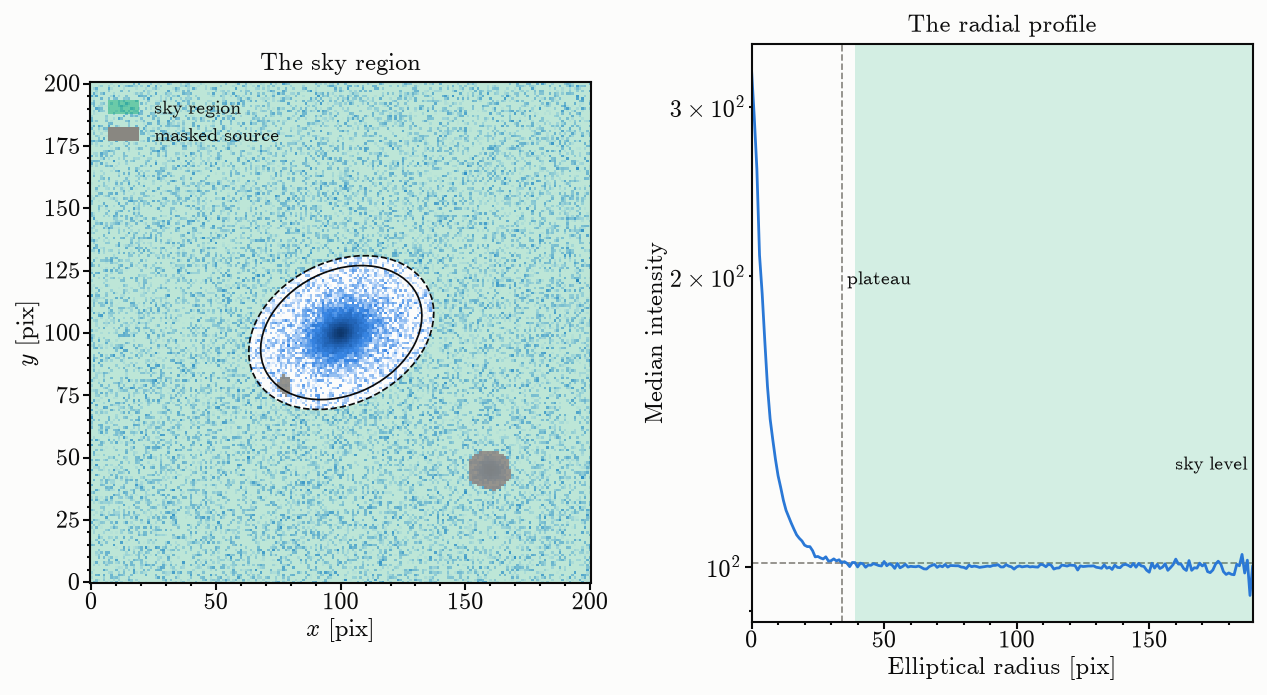
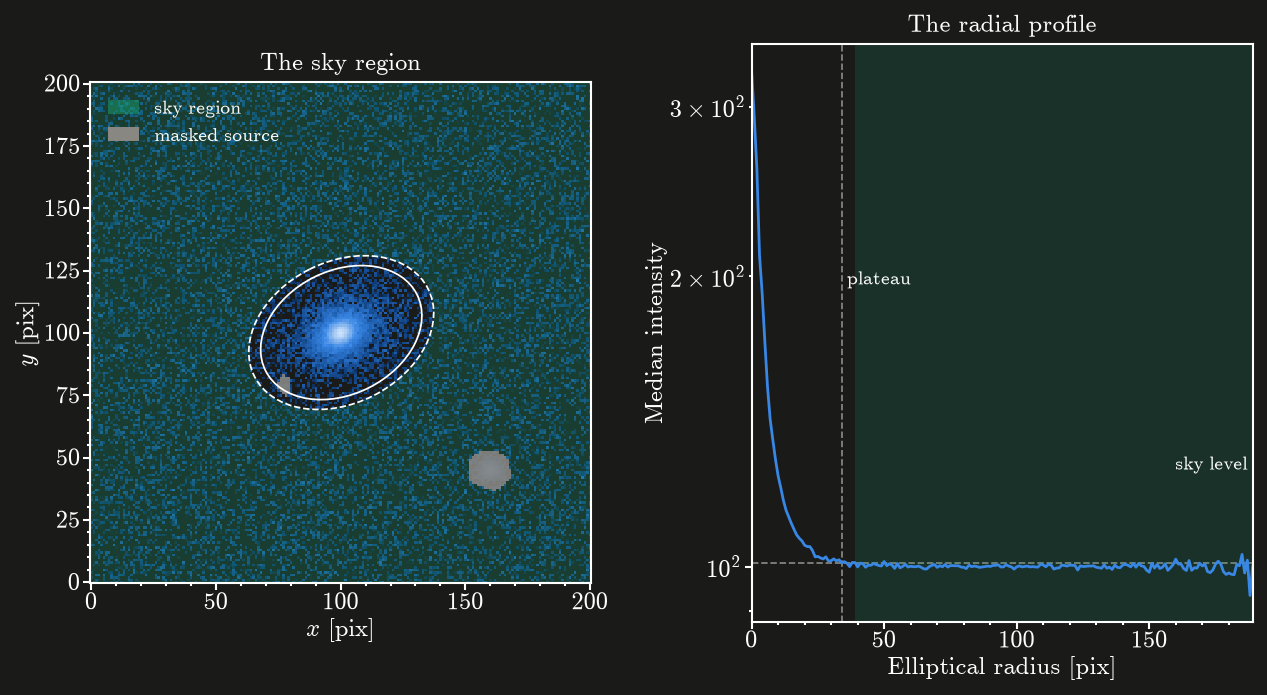
A simulated galaxy on a sky of 100 image units, prepared with the functions of BayMorph. Left: the plateau ellipse (solid), the inner edge of the sky region 5 px beyond it (dashed), the sky region (shaded) and a masked neighbour. Right: the radial profile, which reaches the sky level at the plateau radius.
The faint outskirts of a galaxy are where the sky matters: Sérsic fits are reliable when the effective surface brightness of the galaxy is above that of the sky (Häussler et al. 2007). A sky estimated too close to a galaxy contains part of its light, and subtracting it makes the profile fall faster, which lowers the fitted flux, radius and index. The residual background absorbs a constant error of the subtracted level, but not light of the galaxy that falls off with radius, so the cutout must reach well into the sky: see Target and Cutout.
The residual background
fit.background.model selects one of two forms.
Constant (constant)
| Parameter | Meaning | Units | Default prior |
|---|---|---|---|
background_level |
residual background level | image units | uniform −50 to 50 |
The default prior is not scaled to the image: choose it from the noise and the units of each image.
Plane (plane)
where \(n_x\) and \(n_y\) are the sides of the cutout, so that background_level
is the level at its geometric centre. It is the sky of GALFIT
(Peng et al. 2010): a level at a reference point and two
gradients.
| Parameter | Meaning | Units | Default prior |
|---|---|---|---|
background_level |
level at the centre of the cutout | image units | uniform −50 to 50 |
background_gradient_x |
gradient along increasing \(x\) | image units per pixel | uniform −0.1 to 0.1 |
background_gradient_y |
gradient along increasing \(y\) | image units per pixel | uniform −0.1 to 0.1 |
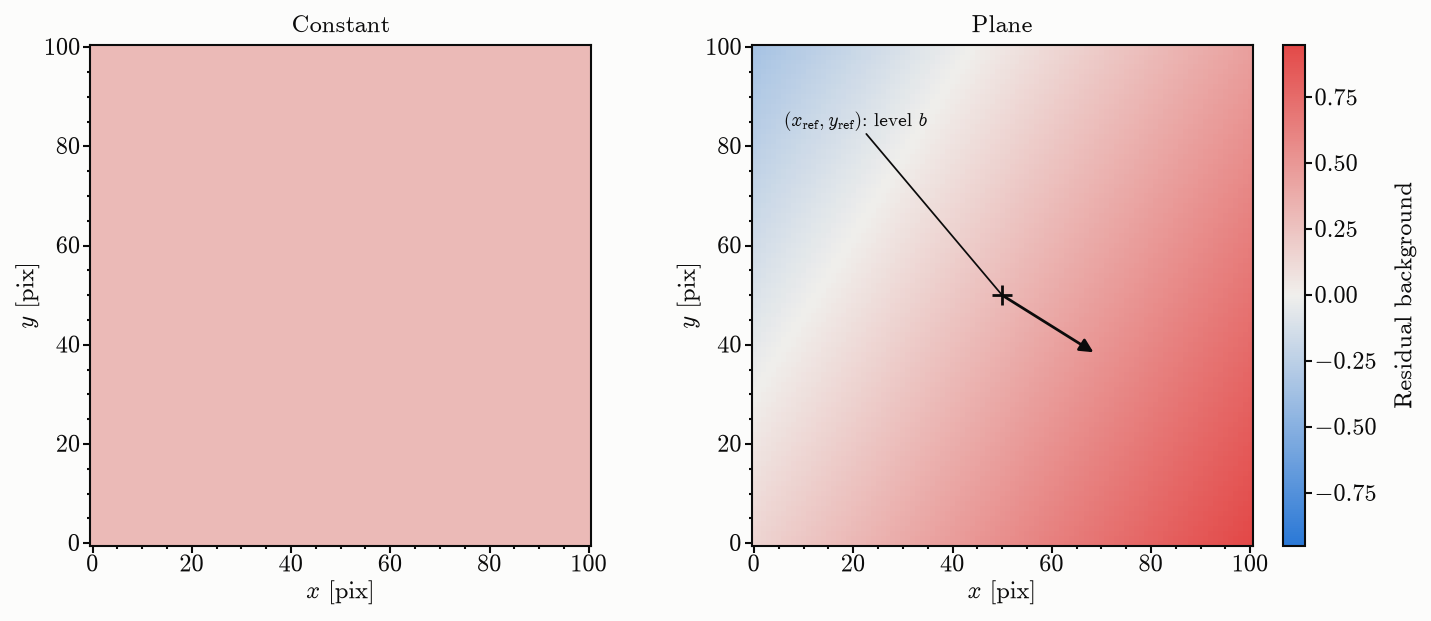
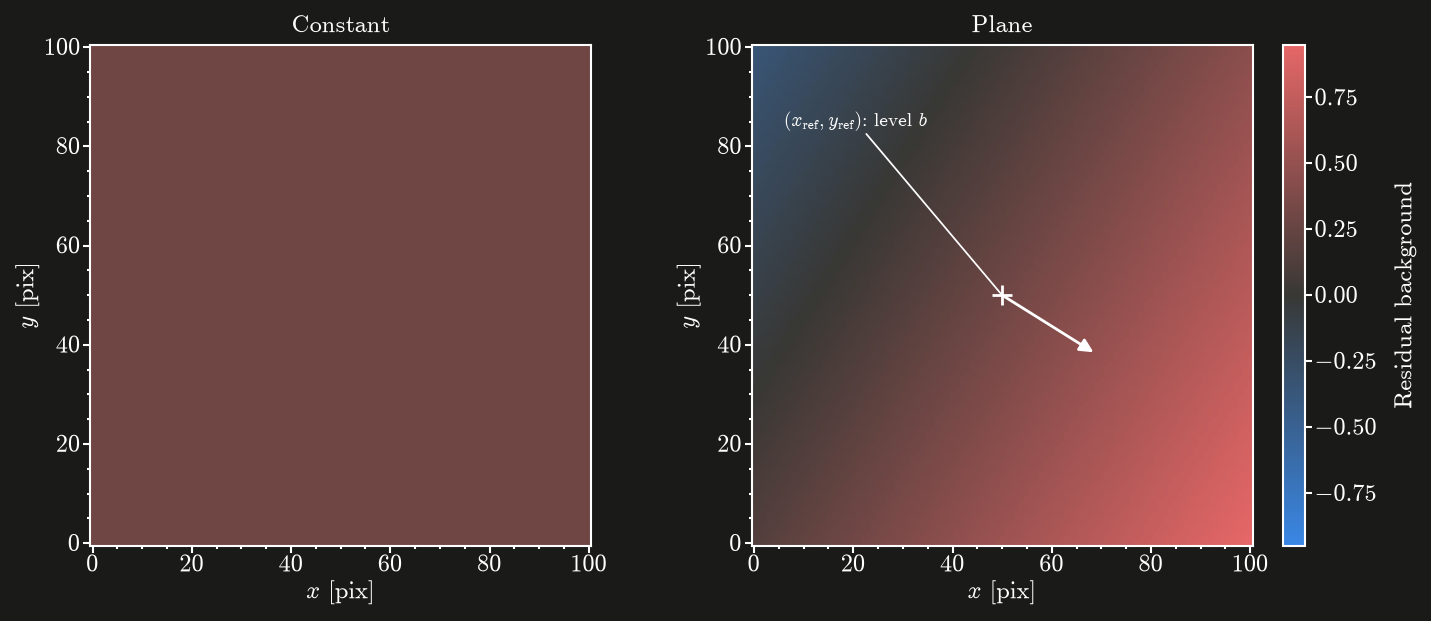
A constant background and a plane with the same level b at the centre of the cutout; the arrow shows the direction of the gradient.
When to use a plane. When the sky gradient that preparation reports is significant at several sigma. The choice remains yours: BayMorph reports the gradient and never switches the model.
In joint fits
The background model is declared once, in the joint fit.background
section, and its parameters are declared under
fit.multi_observation.parameters with independent coupling, because each
image has its own residual background.
Known degeneracies and limits
- The background is anticorrelated with the flux, the radius and the index of the galaxy, which add light far from the centre as it does.
- The sky region may still contain faint light of the galaxy, which biases the subtracted sky; how much, and how best to correct it, is being measured.
- Structure of the sky beyond a plane is not modelled.
Validation
A controlled test fits a simulated image with a known sky gradient and recovers the gradient, removing the residual structure that a constant background leaves.
Python
baymorph.observation.background.ConstantBackground(level) and
TiltedPlaneBackground(level, gradient_x, gradient_y).
References
- Häussler B. et al., 2007, ApJS, 172, 615: the reliability of Sérsic fits against the brightness of the sky.
- Peng C. Y. et al., 2010, AJ, 139, 2097: the tilted-plane sky.